

Workers’ Compensation for Repetitive Stress Injuries in 2026: What Employees Need to Know
Workplace injuries used to bring a very specific image to mind—someone falling from scaffolding, a factory worker caught in heavy equipment, a construction accident that happens in a split second.
That picture is outdated.
The injuries dominating workers’ compensation claims in 2026 are slower, quieter, and far easier to ignore—at least at first. Repetitive Stress Injuries (RSI) have become one of the most common causes of long-term workplace disability. Not because jobs are more dangerous, but because modern work asks the human body to repeat the same movement thousands of times a day.
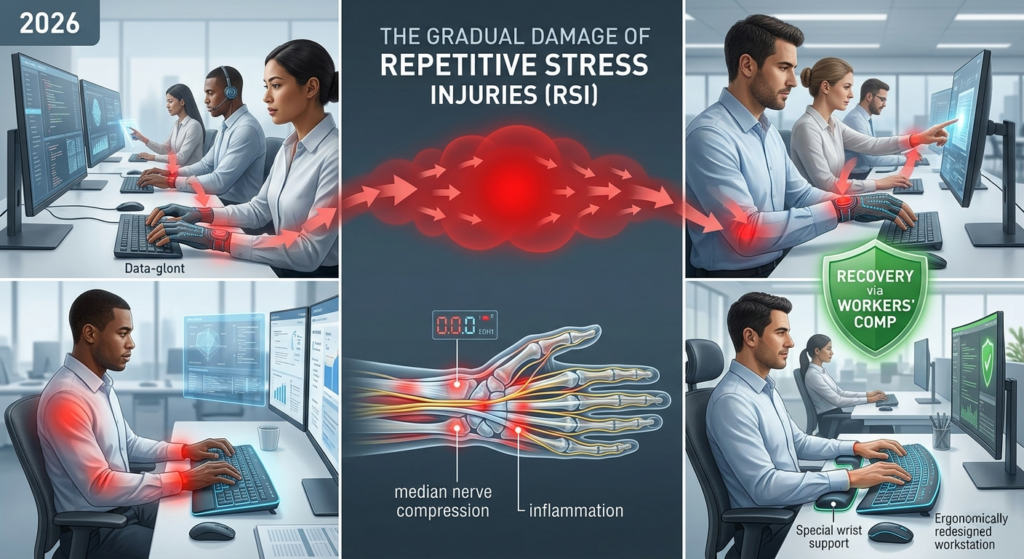
Typing. Scanning. Gripping. Lifting. Swiping.
None of these actions seem harmful in isolation. But repeat them long enough and the damage accumulates.
The real problem? Many employees assume workers’ compensation only applies to dramatic accidents. A fall. A fracture. A visible injury.
That assumption is wrong.
Under U.S. labor law, an injury that develops slowly—over weeks, months, or even years—can qualify for the same legal protection as a sudden accident. If your job duties are the reason your nerves, tendons, or joints are failing, the law recognizes that.
And in many cases, the difference between a denied claim and a successful recovery starts with one step: speaking with an experienced workers comp lawyer for carpal tunnel or RSI who understands how these cases actually work.
The Most Common Work-Related RSIs in 2026
Repetitive Stress Injuries don’t appear overnight. They build gradually, often starting with minor discomfort that workers dismiss as fatigue.
Then the pain lingers. Numbness appears. Grip strength weakens.
Eventually, everyday tasks become difficult.
Different jobs trigger different forms of RSI, but several conditions show up again and again in workers’ compensation claims.
Carpal Tunnel Syndrome
Carpal Tunnel Syndrome remains the most recognized RSI, and for good reason. It occurs when the median nerve running through the wrist becomes compressed.
For years, people blamed keyboards alone. But that’s only part of the story.
Assembly line workers, warehouse packers, dental hygienists, and mechanics often develop the same condition. Any job requiring repeated wrist motion can trigger it.
Tendinitis and Tenosynovitis
These injuries involve inflammation of tendons caused by repeated strain. Workers who constantly grip tools, lift overhead, or perform fast repetitive motions often develop this condition.
Pain usually starts mild.
Then it spreads.
Left untreated, tendon damage can become permanent.
Cubital Tunnel Syndrome
You’ve probably experienced that tingling sensation in your elbow after leaning on it too long. That’s the ulnar nerve reacting to pressure.
Now imagine that pressure happening every day for years.
Cubital Tunnel Syndrome—sometimes called “ulnar nerve entrapment”—is becoming more common as workers spend long hours using laptops, phones, and poorly designed desks.
Epicondylitis (Tennis or Golfer’s Elbow)
Despite the name, most people who develop this injury have never picked up a tennis racket.
Grocery clerks scanning products, warehouse workers lifting boxes, mechanics turning tools—any job involving repetitive wrist extension can inflame the elbow joint.
The key issue in all RSI claims is proving causation. Insurance companies rarely dispute the medical diagnosis. What they question is the source.
Was it work?
Or something else?
That distinction decides whether your claim survives.
Why Timing Matters More Than Most Workers Realize
RSI claims come with a unique challenge: there’s rarely a clear “injury date.”
You don’t fall. Nothing breaks. The pain creeps in slowly.
But workers’ compensation law still requires a reporting deadline.
Legally, the clock usually starts when you knew—or reasonably should have known—that your condition was connected to your job.
Here’s where many workers make a costly mistake.
They wait.
Maybe the pain will fade. Maybe rest will fix it. Maybe reporting it will cause problems with management.
Weeks pass.
Then a doctor confirms the injury is work-related.
By that point, the notification window may already be closing.
In many states, workers must notify their employer within 30 to 45 days of learning their injury is job-related. Miss that deadline and the claim may be rejected automatically.
The safest move is simple:
- Put the report in writing
- State clearly that the injury is work-related
- Do it as soon as a doctor raises the possibility
A short-written statement can preserve your legal rights.
Waiting can destroy them.
Building a Strong RSI Workers’ Compensation Claim
RSI cases live or die based on documentation. A vague description won’t convince an insurance adjuster.
You need specifics.
Work Closely With Your Doctor
When describing symptoms, many patients say something like: “My wrist hurts.”
That’s not enough.
Doctors need context.
Explain exactly what your job requires—how long you type, how often you lift, the speed of your tasks, the motions you repeat all day. Medical reports must connect your injury to your duties in clear terms.
Without that link, insurers will argue the injury came from outside work.
Keep a Symptom Log
Pain fluctuates. Some days feel manageable. Others are unbearable.
Write it down.
Track when symptoms appear, what tasks trigger them, and how they change during your shift. Over time, patterns emerge—and those patterns can become powerful evidence.
Document Your Workstation
Ergonomics matters more than ever.
Inadequate chairs, poorly positioned monitors, or missing wrist support can all contribute to RSI. Photos of your workstation can help demonstrate that your employer failed to provide safe equipment.
Even though workers’ compensation is technically a “no-fault” system, unsafe conditions still strengthen a claim.
Prepare for the Insurance Company’s Doctor
Insurance carriers often require an Independent Medical Examination, or IME.
Despite the name, these evaluations are rarely neutral. The physician is hired by the insurer, and their report can heavily influence the outcome of your claim.
That’s why many injured workers choose to work with an attorney who can challenge questionable medical opinions.
What Happens When a Claim Is Denied
Here’s the uncomfortable truth: RSI claims are denied more often than accident claims.
Insurers use familiar arguments.
They blame aging.
They blame hobbies.
They blame “pre-existing conditions.”
The strategy is simple—create doubt about the cause of the injury.
A denial letter doesn’t mean your case is over. It means the dispute is moving to the next stage.
Workers have the right to appeal through their state’s Workers’ Compensation Board. The process usually involves a formal hearing where an Administrative Law Judge reviews medical records, testimony, and expert opinions.
Legal representation becomes especially important at this stage.
Most workers’ compensation attorneys work on contingency, meaning they only get paid if you win. That structure allows injured workers to challenge large insurance companies without paying upfront legal fees.
Workers’ Compensation Benefits for RSI in 2026
When a claim is approved, workers’ compensation can cover several types of benefits.
Temporary Disability Payments
If your injury prevents you from working during treatment, you may receive Temporary Total Disability (TTD) payments. These typically equal about two-thirds of your average weekly wage, up to a state-specific limit.
Medical Treatment
Coverage includes far more than surgery. Rehabilitation options have expanded significantly in recent years.
Many treatment plans now include advanced physical therapy, motion-tracking recovery systems, and AI-guided ergonomic retraining programs designed to prevent re-injury.
Permanent Disability Compensation
Some RSIs never fully heal.
If nerve damage or loss of function becomes permanent, workers may qualify for Permanent Partial Disability benefits. In many states, this compensation comes as a lump-sum settlement based on the severity of the impairment.
Exact amounts depend on state law and the current maximum weekly compensation rate.
Protecting Your Health—and Your Career
Repetitive Stress Injuries rarely announce themselves dramatically. They whisper.
A tingling hand.
A sore elbow.
A wrist that feels stiff every morning.
Ignore those signals long enough and the damage can become permanent.
Workers should never have to choose between earning a paycheck and protecting their body. The workers’ compensation system exists precisely to prevent that dilemma.
Filing a claim isn’t an attack on your employer. It’s a request for the insurance coverage already built into the system.
If you’re dealing with persistent pain and suspect your job may be responsible, getting professional guidance early can make an enormous difference. Every state applies its own deadlines, rules, and medical standards—and navigating them alone can be risky.
A qualified legal professional can review your job duties, medical records, and claim history to determine whether you have a case.
Sometimes the most important step in recovery isn’t medical.
It’s knowing your rights—and acting before the opportunity disappears.