

The Real Cost of Dental Implants in 2026: A No-Nonsense Guide to Financing Your Smile
Let’s be honest: nobody wakes up excited to drop thousands of dollars on a titanium screw and a porcelain crown. But if you’re struggling with missing teeth, you already know that “saving money” by doing nothing is costing you plenty in other ways. We’re talking about the inability to eat a steak without thinking twice, the dip in self-confidence during a Zoom call, and the literal shifting of your jawbone that happens when a tooth is gone.
By 2026, dental implant technology has become incredibly precise. We’re seeing faster healing times and success rates that hover near 98%. But the elephant in the room hasn’t budged: the price tag. If you’re looking at a $4,000 bill for a single tooth—or $40,000 for a full mouth—you need a strategy, not just a brochure.
The 2026 Price Breakdown: What Are You Actually Paying For?
The “sticker price” of a dental implant is rarely the final number. It’s a surgical process, not a product you buy off a shelf. In 2026, the market has split into two main material camps: Titanium (the reliable workhorse) and Zirconia (the aesthetic powerhouse).
Here’s the reality of what the check looks like for most patients this year:
1. The Single Tooth Replacement
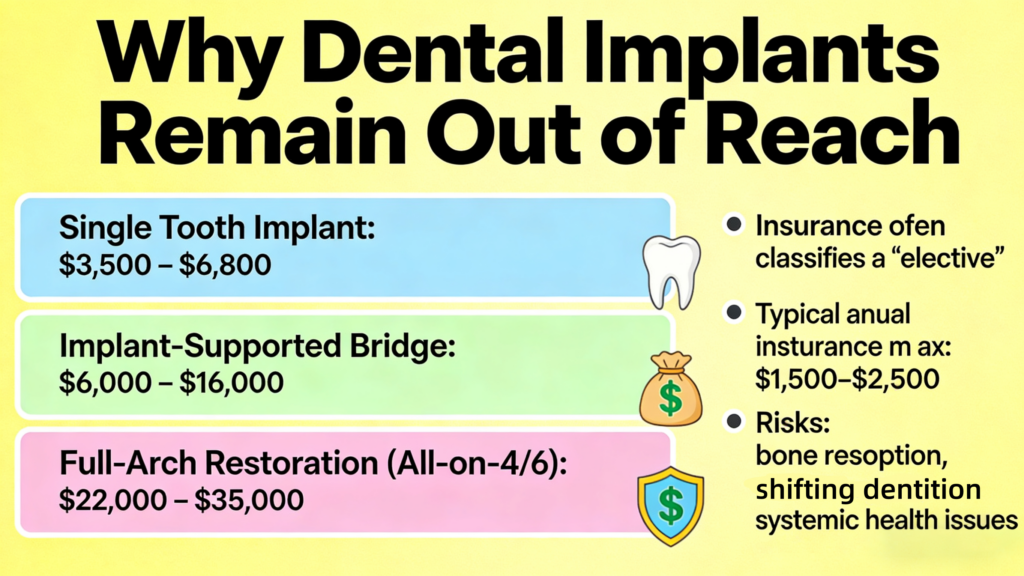
Expect to pay anywhere from $3,500 to $6,800.
This isn’t just for the “tooth.” You’re paying for three distinct parts: the post (the screw in your bone), the abutment (the connector), and the crown (the part people see). If you want a Zirconia crown for a front tooth—which looks more like a natural tooth and doesn’t show a gray metal line at the gum—you’ll likely pay a $500 premium.
2. The Implant-Supported Bridge
If you’re missing three or four teeth in a row, don’t buy three separate implants. A bridge uses two implants to anchor a three- or four-tooth span.
- Average Cost: $6,000 – $16,000.It’s a massive cost-saver compared to individual implants, provided your jawbone is healthy enough to support the anchors.
3. Full-Arch Restoration (The “All-on-X” approach)
This is the “big one.” If you’re replacing an entire upper or lower set of teeth, you’re looking at $22,000 to $35,000 per arch.
The “All-on-4” technique is the standard, but many surgeons in 2026 are leaning toward “All-on-6” for better stability. While All-on-6 costs more upfront due to the extra hardware, it’s often cheaper in the long run because it reduces the risk of mechanical failure.
2026 Material Cost Comparison Table
| Procedure Type | Titanium (Base Cost) | Zirconia (The “Aesthetic” Upgrade) | Pro Tip |
| Single Tooth | $3,500 – $6,800 | + $400 – $700 | Stick with Titanium for back molars; use Zirconia for the “smile zone.” |
| Multi-Tooth Bridge | $6,000 – $16,000 | + $800 – $1,500 | Zirconia bridges are more fracture-resistant for heavy chewers. |
| Full Arch (All-on-4/6) | $22,000 – $35,000 | + $2,000 – $4,000 | Zirconia full-arches resist staining from coffee and wine much better than acrylic. |
The Insurance Trap: Why Your Policy Is Probably Useless
Here is the hard truth: Most dental insurance hasn’t changed its “annual maximum” since the 1970s. Most plans still cap out at $1,500 – $2,500 per year. In 2026, that barely covers the prep work for an implant, let alone the surgery itself.
Worse, many insurers still label implants as “cosmetic” or “elective.” They’d rather pay for a cheap removable denture that needs replacing every five years than a permanent implant. If your insurance covers 50% of an implant, count yourself lucky—but remember, that 50% is still capped by your annual limit.
The “Savings Plan” Workaround
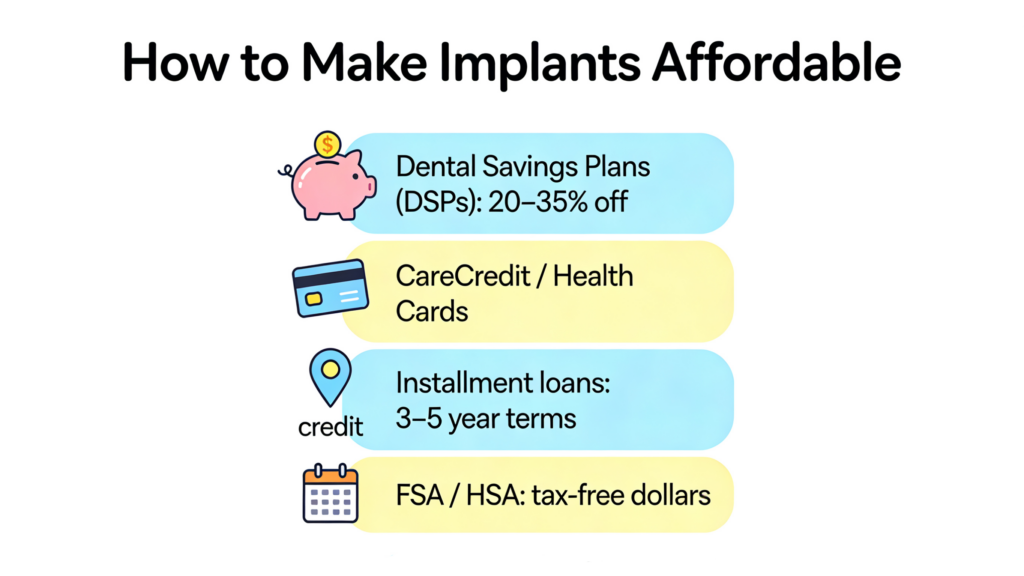
If your insurance is failing you, look into Dental Savings Plans. They aren’t insurance; they’re more like a “Costco membership” for dental work.
- No waiting periods: You can join today and get the discount tomorrow.
- Transparent pricing: You get a fee schedule that shows exactly what the “network price” is.
- The Math: On a $35,000 full-mouth restoration, a savings plan can often knock $8,000 off the bill immediately. That’s a massive win compared to the $1,500 “benefit” from standard insurance.
Financing: How to Pay Without Cashing Out Your 401(k)
Most people don’t have $30,000 sitting in a checking account. In 2026, the way people afford these procedures is through aggressive use of healthcare financing.
The CareCredit “Trap” and “Triumph”
CareCredit is the industry giant. They offer 0% APR promotional periods (usually 6 to 24 months).
- The Triumph: If you finance a $12,000 procedure over 12 months and pay exactly $1,000 a month, you pay zero interest. It’s free money.
- The Trap: If you owe even $1.00 at the end of month 12, they will back-charge you interest on the entire $12,000 from day one. At 26% or higher interest, that “deal” just became a nightmare.
Modern Alternatives for 2026
- Sunbit: They’ve become very popular because they have extremely high approval rates (over 85%). If your credit isn’t perfect, Sunbit is usually the first place to look for small-to-midsize dental loans.
- LendingPoint: This is better for the big “Full-Arch” jobs. These are fixed-rate personal loans with terms up to 36 or 48 months. The interest isn’t 0%, but the monthly payment is predictable and won’t skyrocket if you’re a day late.
Location: The “Geography Tax”
You might love living in Manhattan or downtown San Francisco, but your wallet will hate it when it’s time for surgery. In 2026, the “geographic spread” for dental work is wider than ever.
If you get a quote for $6,000 for a single implant in a high-cost-of-living city, it might be worth driving two hours into the suburbs or a smaller metro area. Offices in rural areas or smaller cities (think Columbus, OH or Austin, TX suburbs) often have lower overhead and can charge 20% less for the exact same titanium post and the exact same surgical expertise.
The Bottom Line
Actually getting dental implants in 2026 is a math problem, not just a medical one. To make this work, you have to be your own advocate. Don’t just take the first quote your dentist gives you.
Actually, here’s the “cheat code” for 2026:
- Get a Dental Savings Plan to lower the base price.
- Use CareCredit for the 0% interest period, but only for an amount you know you can pay off.
- Finance the remainder through a fixed-term loan like Sunbit or LendingPoint.
It’s an investment in your health that lasts 25+ years. Treated correctly, these implants will outlast your car, your roof, and maybe even your house.