

Section 179 Deductions in 2026: How Smart Businesses Turn Equipment Purchases Into Major Tax Savings
Most business owners feel the pressure right now. Equipment costs are climbing. Software subscriptions pile up. And if you’re running anything from a manufacturing shop to a digital agency, you’re probably upgrading systems faster than ever.
Here’s the good news: the tax code quietly rewards that kind of investment.
One rule in particular—the Section 179 deduction—lets businesses turn equipment purchases into immediate tax savings. Instead of stretching deductions across years of depreciation, you can often write off the entire cost in the same year you buy the equipment.
That changes the math dramatically.
A server upgrade. New CNC machines. Even certain vehicles. In many cases, those purchases can wipe out a huge chunk of your taxable income.
And in 2026, the limits are higher than ever.
Section 179 Limits for 2026: The Numbers That Matter
Every year, the IRS adjusts Section 179 limits to keep pace with inflation. For 2026, the numbers are large enough that most small and mid-size businesses will never hit the ceiling.
Here’s what you need to know.
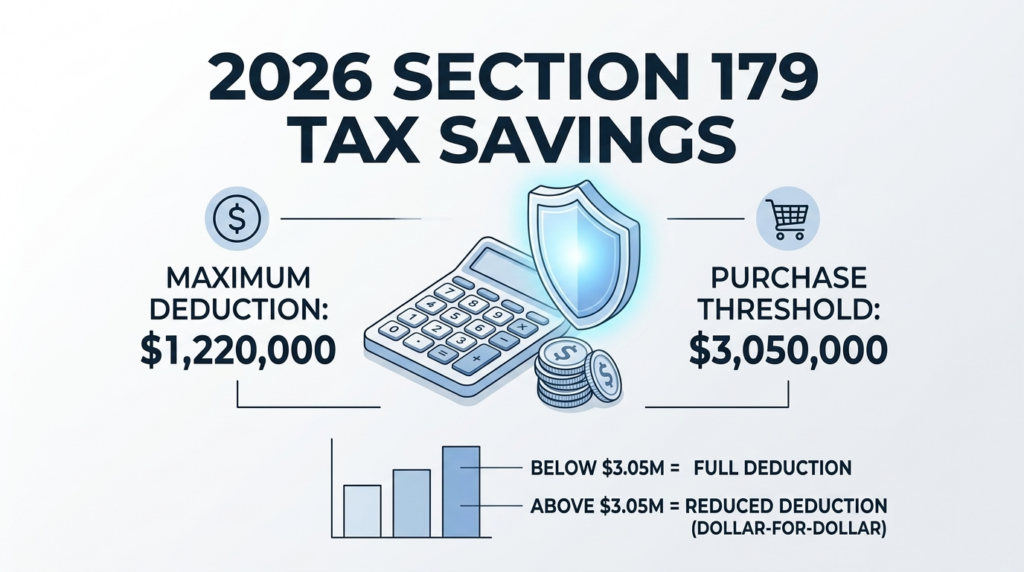
- Maximum Section 179 Deduction:$1,220,000
- Equipment Purchase Phase-Out Threshold:$3,050,000
In plain English: a business can deduct up to $1.22 million in qualifying equipment purchases during the 2026 tax year.
But there’s a catch once spending climbs too high.
The deduction begins shrinking once your total equipment purchases exceed $3.05 million. After that point, every additional dollar reduces your Section 179 deduction by one dollar.
Eventually, it disappears completely.
If your business spends more than $4.27 million on equipment in 2026, Section 179 is effectively gone. At that stage, companies typically shift to bonus depreciation to capture additional write-offs.
For most SMBs, though, that phase-out rarely becomes a problem.
A Real-World Example: Modernizing a Manufacturing Shop
Numbers make more sense with a real scenario.
Imagine a mid-sized woodworking operation upgrading its facility in 2026. The owner decides to modernize production and purchases:
- CNC routers
- automated dust collection systems
- a new delivery van
- upgraded design workstations
Total equipment spending for the year: $2,800,000.
Because the company remains under the $3.05 million threshold, the business can immediately claim the full $1,220,000 Section 179 deduction.
That leaves $1,580,000 in remaining equipment value.
Now bonus depreciation enters the picture. If applied, that remaining amount may also be written off quickly, depending on current tax rules.
Result?
A multi-million-dollar equipment upgrade can reduce—or even eliminate—taxable income for the year.
That’s not a loophole. It’s exactly what the rule was designed to do: encourage companies to invest in growth.
What Qualifies for a Section 179 Deduction?
A lot of people still think Section 179 only applies to heavy machinery.
That’s outdated thinking.
Today’s businesses run on digital infrastructure just as much as physical equipment. The IRS recognizes that, and the list of Section 179 eligible assets is broader than many owners realize.
Let’s break down the most common categories.
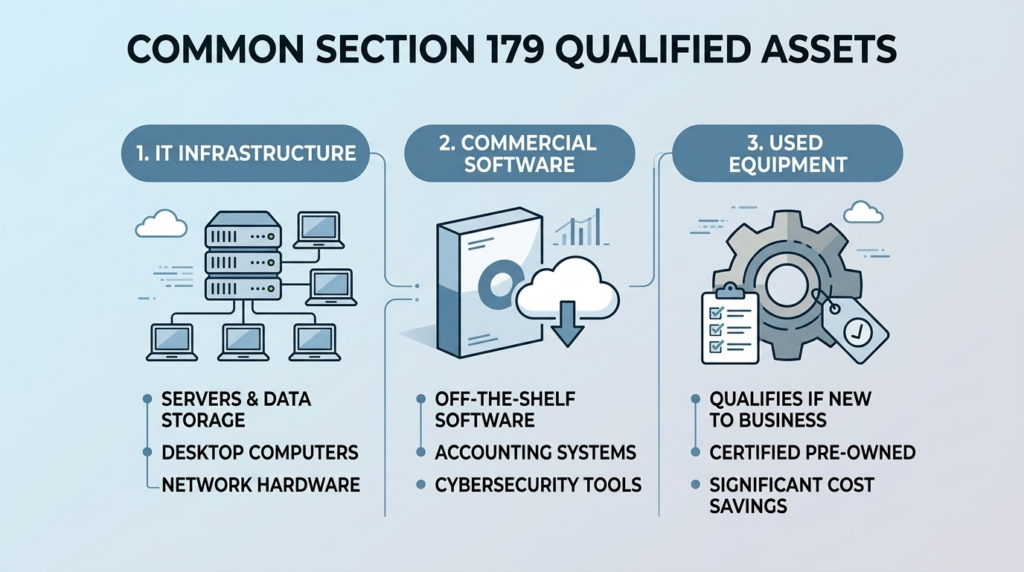
Computer Hardware and IT Infrastructure
Technology upgrades are among the easiest deductions to qualify.
Typical examples include:
- servers and data storage systems
- desktop computers and workstations
- laptops issued to employees
- networking hardware and switches
If your business purchased the equipment and uses it primarily for operations, it usually qualifies.
That includes infrastructure supporting AI workloads or large data processing systems.
Off-the-Shelf Software
Software spending is now one of the largest operating costs for many companies.
Fortunately, commercial software typically qualifies for Section 179 as long as it meets a few criteria:
- available to the general public
- not custom-developed exclusively for your company
- purchased rather than internally built
Examples include:
- CRM platforms
- accounting software
- CAD design tools
- cybersecurity systems
If you bought a license to run the business, chances are it counts.
Office Equipment and Furniture
Even the basics can qualify.
That includes:
- desks and office furniture
- conference room equipment
- printers and high-volume copiers
- specialized workspace equipment
Individually these purchases may seem small. Together they can represent significant tax deductions.
New vs. Used Equipment: A Surprisingly Powerful Rule
Here’s something many business owners overlook.
Section 179 does not require brand-new equipment.
Used equipment qualifies as long as it’s new to your business.
That means if you purchase certified pre-owned machinery, refurbished servers, or previously owned production equipment, the deduction still applies.
For startups and growing companies, this rule can be extremely valuable.
Instead of paying full price for new equipment, you can purchase high-quality used machines at a discount and still claim the full deduction.
That’s a rare situation where both accounting strategy and cost savings line up perfectly.
The 6,000-Pound Vehicle Rule Explained
Vehicles are where Section 179 gets interesting.
Most standard passenger cars have strict depreciation limits. The IRS doesn’t want businesses writing off luxury sedans simply because they occasionally drive to meetings.
But heavier vehicles fall under a different set of rules.
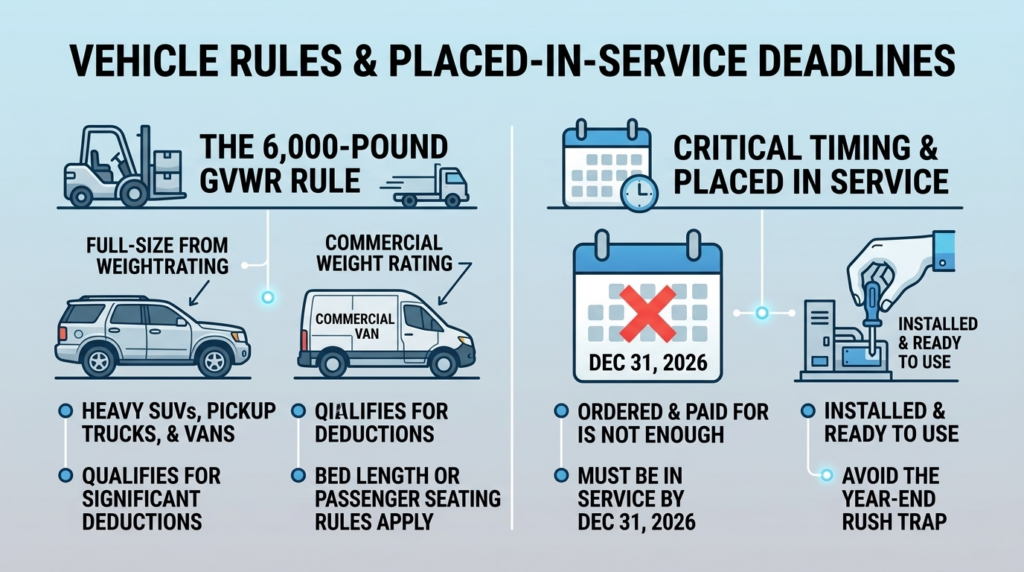
If a vehicle has a Gross Vehicle Weight Rating (GVWR) above 6,000 pounds, it may qualify for significantly larger deductions under Section 179.
That category includes many:
- full-size SUVs
- heavy crossovers
- pickup trucks
- commercial vans
SUV Deduction Limits
For SUVs with a GVWR above 6,000 pounds but below 14,000 pounds, the Section 179 deduction is generally capped.
In 2026, businesses can typically deduct up to about $30,000 of the purchase price using Section 179.
The remaining value may still qualify for bonus depreciation, depending on current tax rules.
Pickup Trucks and Work Vans
Some vehicles receive even more favorable treatment.
Pickup trucks with cargo beds at least six feet long—and traditional work vans without rear passenger seating—may qualify for full 100% deductions.
These vehicles are clearly classified as work equipment, which is why the IRS applies more generous rules.
Quick tip: before buying any vehicle for tax purposes, check the GVWR label inside the driver-side door frame. That number determines eligibility.
Bonus Depreciation in 2026: The Other Half of the Strategy
Section 179 alone can create huge deductions, but it has one limitation.
You generally cannot use it to create a net business loss.
If your deduction exceeds your taxable income, the excess may carry forward rather than immediately reducing taxes.
This is where bonus depreciation becomes valuable.
Unlike Section 179, bonus depreciation:
- has no dollar limit
- can create a tax loss
- automatically applies to entire asset classes
After several years of reduced percentages, lawmakers have pushed to restore 100% bonus depreciation for 2026.
If that policy holds, businesses could deduct the full remaining cost of qualifying equipment after applying Section 179.
The two rules work together.
First, apply Section 179 to the assets you want to deduct immediately. Then use bonus depreciation on the remaining equipment value.
The result can be massive first-year deductions.
Timing Matters: The “Placed in Service” Rule
There’s one detail that trips up a lot of business owners.
To claim a Section 179 deduction for 2026, the equipment must be placed in service before December 31, 2026.
That phrase has a very specific meaning in tax law.
It does not mean:
- ordered
- paid for
- shipped
It means the equipment must be installed and ready for use in your business.
If you order servers in late December but they sit unopened until January, the deduction moves to the following tax year.
Many companies rush purchases at the end of December only to discover they missed the deadline.
Don’t make that mistake.
Why Section 179 Is Still One of the Best Tax Strategies for Growing Businesses
At its core, Section 179 rewards investment.
The government wants companies buying equipment, expanding operations, and upgrading infrastructure. The deduction exists to make those decisions easier.
And for many businesses, the impact is huge.
Instead of slowly depreciating equipment over five or seven years, you recover the cost immediately. That frees up cash flow and lowers the real cost of expansion.
Manufacturers use it. Tech startups use it. Logistics companies rely on it constantly.
Any business purchasing equipment should at least run the numbers.
Because sometimes the smartest move isn’t delaying that upgrade.
Sometimes the smartest move is buying it now—and letting the tax code help pay for it.