

Rideshare Accident Liability: Suing Uber or Lyft in 2026
The New Frontier of Rideshare Litigation
When you’re involved in a crash, the first question isn’t just “Who’s at fault?” It’s often: “Which insurance policy applies?” That distinction can mean the difference between a denied claim and a multi-million-dollar payout. If you find yourself in this situation, consulting an experienced Uber or Lyft accident lawyer in 2026 isn’t optional—it’s essential.
Decoding the Three Insurance Periods
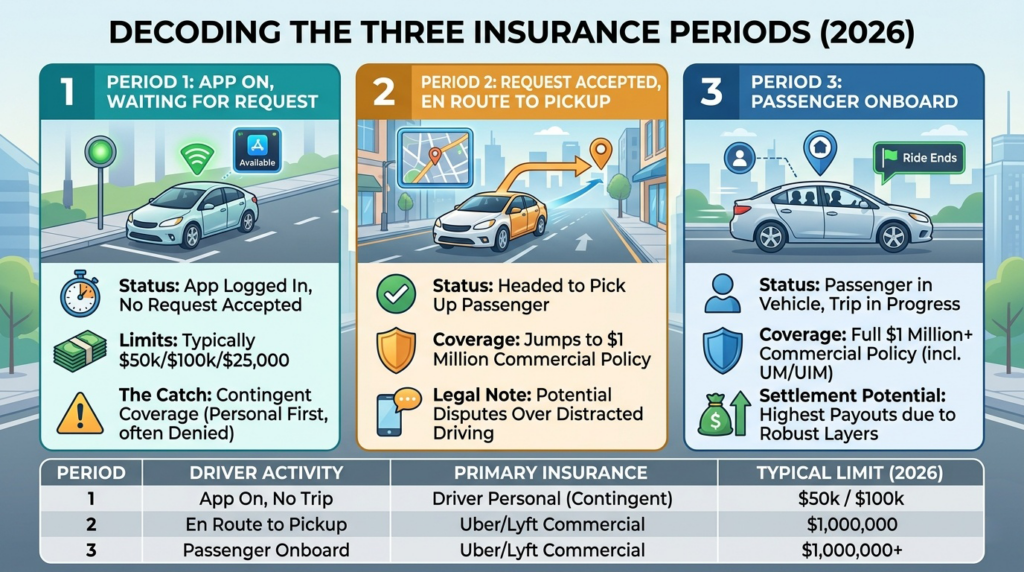
At the heart of every rideshare claim is the concept of the insurance period. In 2026, these tiers are still standard, but coverage gaps have grown. Understanding them can make or break your case.
Period 1: App On, Waiting for a Request
- Status: Driver logged in but hasn’t accepted a ride.
- Coverage: Low limits, typically $50,000/$100,000/$25,000.
- The Catch: Uber and Lyft only offer contingent coverage. You must exhaust the driver’s personal insurance first—which often denies claims, since the car was being used for profit.
Period 2: Request Accepted, En Route to Pickup
- Status: Driver accepted a ride and is heading to pick up the passenger.
- Coverage: Jumps to a $1 million commercial policy.
- Legal Note: Disputes often arise over distracted driving, as drivers interact with the app while navigating.
Period 3: Passenger Onboard
- Status: Passenger in the vehicle until the ride officially ends.
- Coverage: Full $1 million+ commercial policy, including Uninsured/Underinsured Motorist (UM/UIM) coverage.
- Settlement Potential: Highest payouts, thanks to robust insurance layers.
Passenger Rights in 2026: The UIM Advantage
If you’re a passenger, you occupy a legal “safe harbor.” Almost always, you are the non-negligent party. Even if a hit-and-run or third-party driver causes the crash, you are covered.
Recent legislative updates have raised mandatory UIM limits for rideshare companies. If a poorly insured driver strikes your Uber or Lyft, the platform’s massive commercial policy can cover medical bills, lost wages, and pain and suffering.
Pro Tip: Immediately screenshot your active trip in the app after an accident. That digital timestamp is often the smoking gun proving the incident occurred during Period 3.
Suing the Giant: Agency and Control
The legal battlefield has shifted. For years, Uber and Lyft hid behind the “independent contractor” label. But the 2026 Arizona Bellwether Trial changed the game.
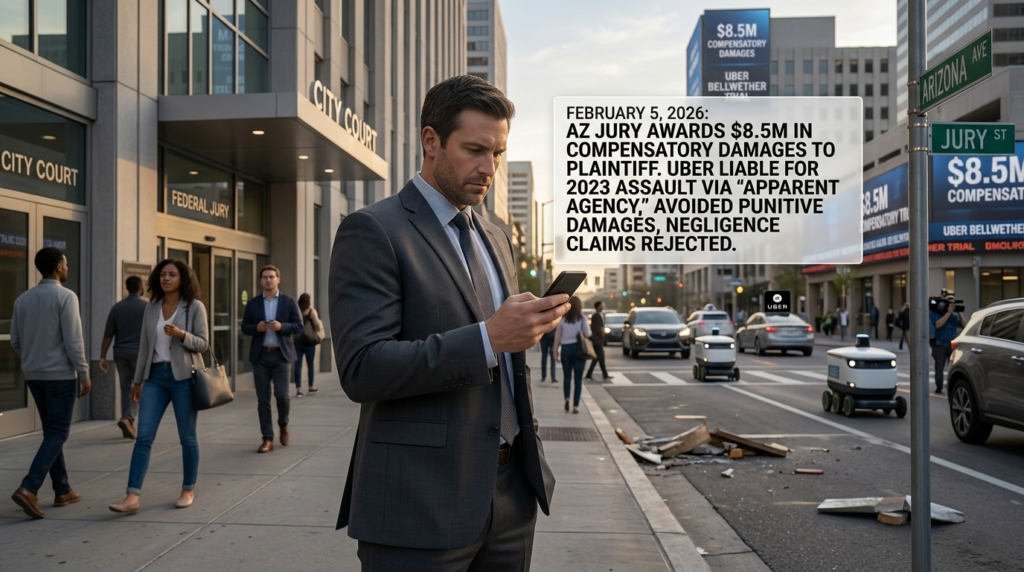
The jury concluded that platforms exercise “pervasive control”: routing via proprietary GPS, nudging drivers to avoid breaks, incentivizing high acceptance rates. In essence, the algorithm had its hands on the wheel.
To hold Uber accountable, lawyers now focus not just on the driver but on the platform’s systemic pressure. Fatigue, distracted driving, and reckless speeding are no longer just “driver errors”; they’re corporate liability.
Evidence Beyond the Crash Scene
A rideshare accident isn’t just bumper photos. In 2026, digital evidence is king. Attorneys must obtain:
- App Activity Logs: Was the driver toggling between Uber, Lyft, and food delivery apps?
- GPS and Speed Data: Were brakes slammed or speeds excessive seconds before impact?
- Algorithmic Dispatch Records: Did surge pricing or streak bonuses push the driver to take risks?
If you don’t secure this before the platform archives or deletes it, your case suffers.
Don’t Let the Algorithm Decide Your Claim
Rideshare litigation in 2026 is an arms race. Uber and Lyft deploy top-tier defense teams using advanced data to minimize payouts. They might try to reclassify your accident as Period 1, or blame a phantom third party.
Ask yourself: do you know which insurance period applies? If there’s ambiguity, the insurer will exploit it.
You need a specialized legal team that has faced these tech giants head-on. Many top firms offer free case reviews, letting you understand your claim’s potential without upfront costs.
Don’t settle for a standard car accident payout. When a multi-billion-dollar platform is involved, your compensation should reflect your injuries and the corporation’s responsibility. Reach out to an experienced Uber/Lyft accident lawyer to protect your rights in this digital transit era.