

Multi-Vehicle Car Accidents in 2026: A Practical Legal Checklist for Protecting Your Claim
A typical two-car crash is messy, but the investigation is usually manageable. One driver runs a red light. Another follows too closely. Insurance companies sort it out.
Suddenly nobody remembers what happened. Drivers blame the person behind them. Witnesses disagree. Insurance carriers start protecting their own interests immediately.
Multi-vehicle accidents are different. They’re chaotic, legally complicated, and often extremely expensive. If you’re caught in one, the steps you take during the first hour—and the first 24 hours afterward—can make or break your injury claim.
I’ve seen it happen repeatedly. People assume everything will work itself out. It doesn’t.
Here’s what actually protects you.
Why Multi-Vehicle Accidents Turn Into Legal Chaos
The core problem is simple: multiple impacts create multiple liability theories.
In a chain-reaction crash, the first collision might involve two vehicles. But the force can push cars into others, creating a domino effect. Now there are five drivers, five insurance companies, and five different versions of the story.
Everyone has something to lose.
That’s why drivers instinctively start pointing fingers.
Driver A says they stopped safely.
Driver B insists they were pushed forward.
Driver C claims someone else caused the original crash.
Sorting out the truth requires evidence—real evidence, not guesses. That’s why you should treat the accident scene like the opening stage of a legal investigation.
Step One: Secure the Scene and Call 911
Safety comes first. Always.
If your vehicle is drivable and you’re stuck in an active lane, move to the shoulder or a safe area as quickly as possible. Secondary collisions are common in multi-car accidents, especially on highways.
Then call 911 immediately.
A police report isn’t just paperwork. It becomes the foundation of any injury claim. Insurance companies rely heavily on the officer’s observations, diagrams, and witness statements when assigning fault.
Without that report, the case becomes much harder to prove.
Even if injuries seem minor, insist that officers document the incident.
Step Two: Capture the Entire Scene on Video
Most people take two or three quick photos after an accident. That’s better than nothing—but in a multi-vehicle collision, it’s rarely enough.
Instead, use your phone to record a full 360-degree video of the accident scene.
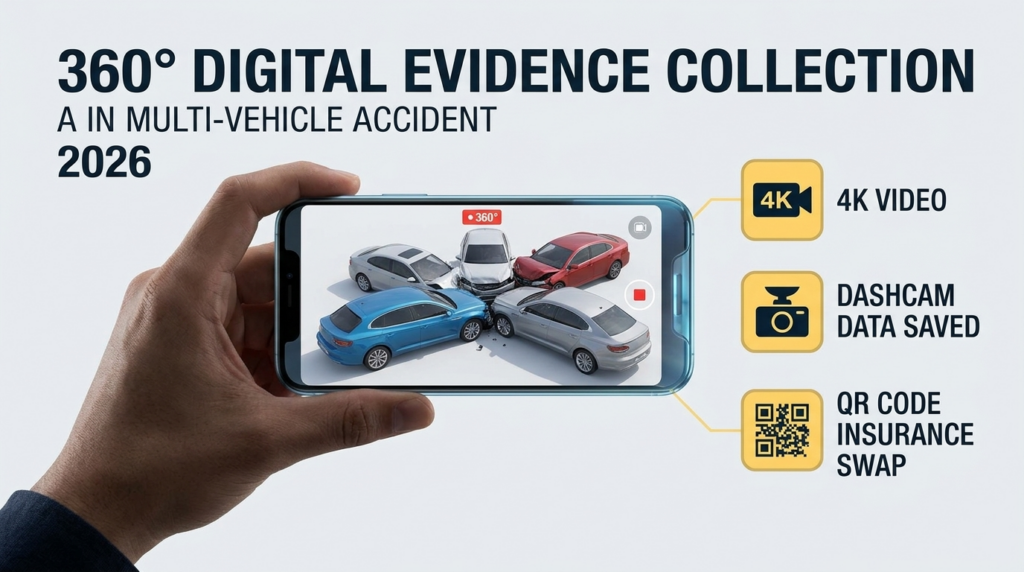
Walk slowly around the area while filming. Capture everything:
- Vehicle positions
- Damage to each car
- Skid marks on the road
- Traffic signs and signals
- Weather and road conditions
Why does this matter?
Because vehicles are usually moved within minutes. Tow trucks arrive. Traffic resumes. Evidence disappears fast.
That short video may become the clearest record of what actually happened.
Step Three: Preserve Dashcam Footage Immediately
By 2026, dashcams are standard in many vehicles, often recording 360-degree video automatically.
If your car has one, save the footage right away. Some systems overwrite data within hours.
Also ask nearby drivers if they have dashcams. Many will.
This footage can become incredibly valuable because it captures events before the collision—including braking patterns, lane changes, and traffic flow.
Unlike driver statements, video doesn’t change its story.
Insurance companies trust it. So do juries.
Step Four: Exchange Digital Insurance Information
In older accident checklists, drivers were told to exchange insurance cards manually.
Today most insurance companies issue digital IDs with QR codes.
Use your phone to scan:
- Insurance information
- Vehicle registration
- Driver identification
And here’s an important detail people miss in pileups.
You need information from every driver involved, not just the one who hit your car. In chain-reaction crashes, liability may trace back several vehicles.
The driver who struck you may not be the one legally responsible.
Hidden Injuries After Multi-Vehicle Collisions
One of the biggest mistakes people make sounds harmless.
“I’m okay. Just a little shaken.”
That reaction is extremely common after a crash. Adrenaline floods your system and temporarily blocks pain signals.
But multi-vehicle collisions often produce multiple impacts from different directions. The body absorbs sudden forces it wasn’t designed to handle.
Symptoms frequently appear later.
Whiplash, Soft Tissue Damage, and Traumatic Brain Injuries
Certain injuries develop slowly.
Whiplash, for example, may take 24 to 72 hours before stiffness and pain appear. Soft-tissue tears behave the same way. Even mild traumatic brain injuries (TBIs) can take time before symptoms become obvious.
Headaches.
Blurred vision.
Difficulty concentrating.
If you delay medical care for several days, insurance companies will immediately question your claim.
Their argument is predictable: the injury must have happened somewhere else.
Maybe at the gym.
Maybe lifting groceries.
It sounds ridiculous—but it works surprisingly often.
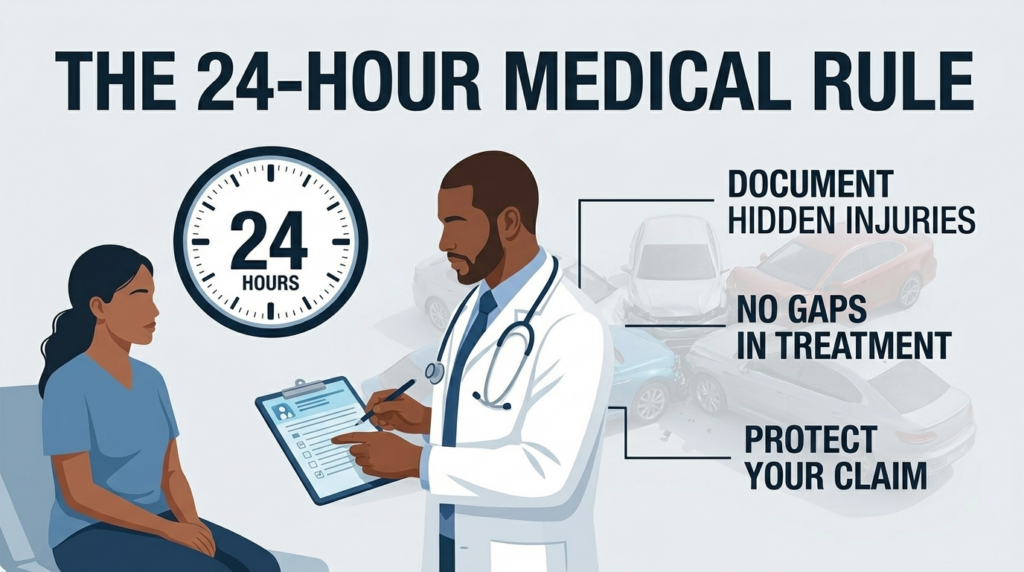
That’s why experienced injury attorneys recommend medical evaluation within 24 hours, even if you feel fine. Emergency rooms or urgent care clinics can document early symptoms and rule out serious trauma.
In legal terms, this prevents what insurers call a “gap in treatment.”
And gaps in treatment destroy claims.
Talking to Insurance Adjusters Without Hurting Your Case
Soon after the crash—sometimes within hours—you may receive calls from insurance adjusters.
They’ll sound polite. Friendly, even.
But their job is not to help you. Their job is to limit the amount their company pays.
That means they’re listening carefully for statements that suggest partial fault.
Here’s where people accidentally damage their own cases.
Simple phrases can be misinterpreted.
“I’m sorry.”
“I didn’t see them.”
“I might have braked late.”
Legally, those comments can be logged as admissions of liability.
Instead, stick to neutral language.
If an adjuster requests a recorded statement, a safer response is straightforward:
“I’m not prepared to provide a recorded statement until I’ve spoken with legal counsel.”
That sentence protects your rights while keeping the conversation professional.
How Liability Is Actually Determined in Pileups
Multi-car accidents rarely place blame on just one driver.
Investigators typically look for the initiating event—the first mistake that triggered the chain reaction.
Maybe someone slammed the brakes without warning.
Maybe a distracted driver rear-ended a line of stopped vehicles.
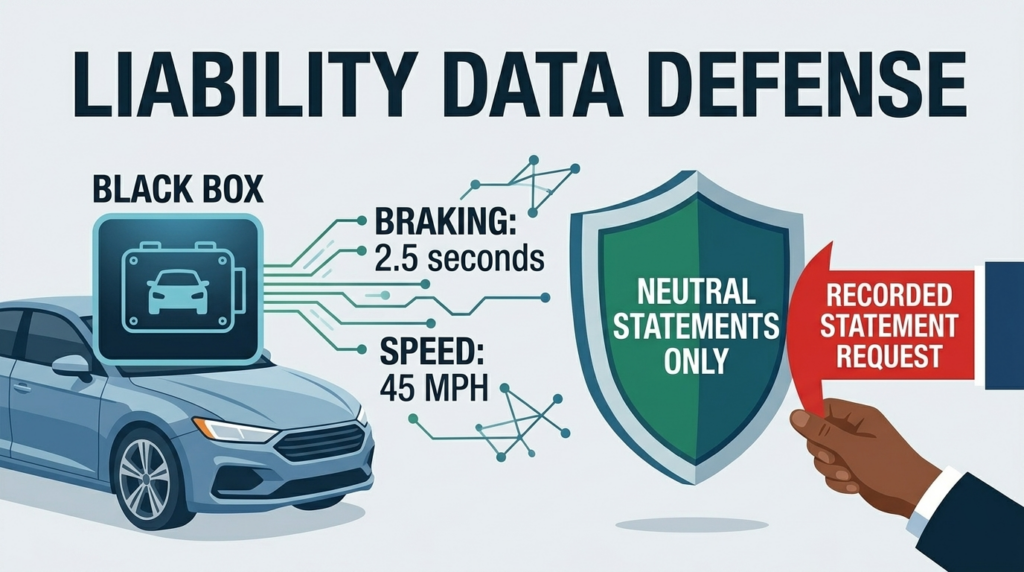
In 2026, accident investigations rely heavily on vehicle data recorders, sometimes called automotive “black boxes.”
These devices capture critical information such as:
- Speed before impact
- Braking time
- Steering input
- Airbag deployment
- Autonomous driving activity
Accident reconstruction specialists combine this data with AI-based modeling to recreate the collision.
The result is often far more accurate than eyewitness accounts.
Comparative Negligence and Partial Fault
Another legal reality surprises many drivers.
Even if you share some responsibility for the accident, you may still recover damages.
Most U.S. states follow comparative negligence laws. Under these rules, compensation is reduced based on your percentage of fault.
For example:
If your damages total $100,000 and you’re found 10% responsible, you can still recover $90,000.
But establishing those percentages requires strong evidence. Without it, insurers will assign more blame to you than is justified.
When Hiring an Attorney Becomes Critical
Handling a minor fender-bender alone might be manageable.
A multi-vehicle accident is another story entirely.
Now there may be:
- Multiple drivers
- Multiple insurance policies
- Competing liability claims
Each insurer wants someone else to pay. When that happens, the unrepresented driver often becomes the easiest target.
Experienced car accident attorneys step in to change that dynamic.
They handle communications with insurers, gather evidence, and identify every possible source of compensation.
Sometimes that includes umbrella policies or commercial coverage if a delivery driver or rideshare vehicle was involved.
Those additional policies can dramatically increase the available settlement.
The Real Value of Legal Representation
Insurance companies often attempt quick payouts after complicated accidents.
These are sometimes called “nuisance settlements.” The idea is simple: offer a small check early and close the case before the full cost of injuries becomes clear.
Without legal guidance, many victims accept these offers.
That’s a mistake.
Serious injuries often require months of treatment—physical therapy, follow-up imaging, and time away from work. A settlement should account for all of those costs, including future care.
Experienced attorneys push for compensation that reflects the true long-term impact of the accident, not just the immediate medical bills.
A Simple Survival Checklist After a Multi-Car Accident
If you’re ever involved in a multi-vehicle crash, remember these five steps.
They may protect your safety—and your legal rights.
- Call 911 immediately and ensure a police report is created.
- Document the entire scene using photos and 4K video.
- Save all dashcam footage and request copies from witnesses if possible.
- Seek medical evaluation within 24 hours, even if symptoms seem minor.
- Avoid recorded insurance statements until you’ve spoken with a lawyer.
One Final Reality
Car accidents are stressful. Multi-vehicle crashes amplify that stress dramatically.
But the decisions you make in those first few hours matter.
Evidence disappears quickly. Memories fade. Insurance companies move fast.
If you treat the situation carefully—document everything, seek medical care promptly, and protect your legal position—you give yourself the best chance of recovering fair compensation.
And when multiple insurance companies are involved, that preparation can make all the difference.