

Managing Fleet Vehicles in 2026: GPS Tracking, Fuel Control, and Smart Fleet Tech
Running a fleet used to be about dispatch boards, driver calls, and gut instinct.
So the industry shifted. Fast.
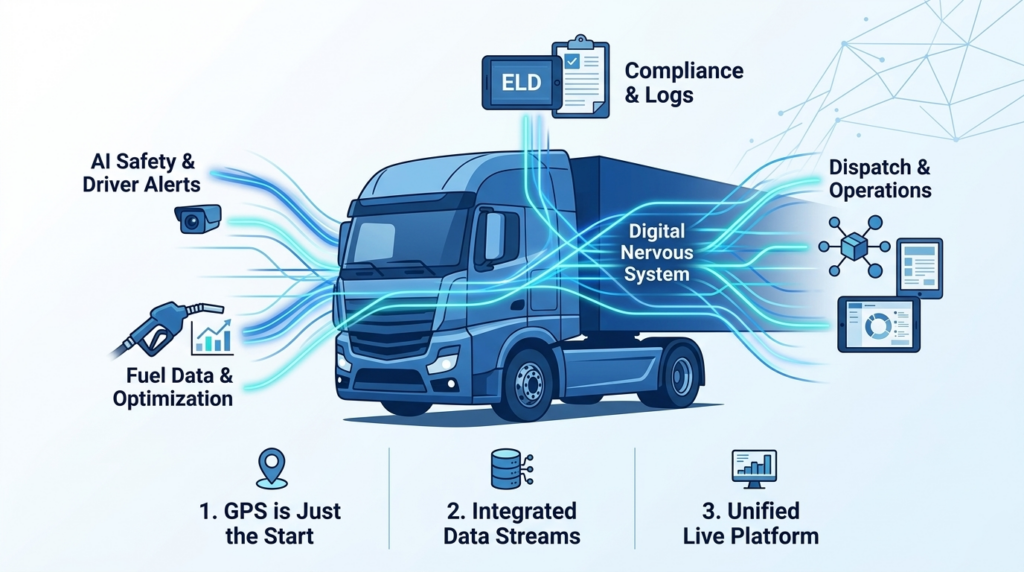
What used to be “nice-to-have” technology—GPS tracking, AI safety monitoring, fuel analytics—has become essential infrastructure. The best fleet tracking software in 2026 doesn’t just show truck locations on a map. It connects vehicles, drivers, dispatch, compliance records, and fuel spending into one live system.
Think of it as the digital nervous system of a modern fleet.
And if your operation still relies on manual logs and basic GPS pings, you’re almost certainly leaking money every day.
Modern Fleet Tracking: GPS Is Just the Starting Point
A decade ago, GPS tracking solved one problem: knowing where your vehicles were.
Today’s systems go far beyond that. They analyze driver behavior, predict maintenance issues, monitor fuel consumption, and help fleets prove compliance with federal regulations.
Three major platforms dominate the U.S. market right now. Fleet managers usually end up comparing Samsara vs Verizon Connect pricing while also evaluating a third strong contender: Motive.
Each one approaches fleet management a little differently.
The Big Three Fleet Platforms
Samsara
Samsara built its reputation on an integrated approach. Hardware, software, cameras, sensors—everything lives inside one ecosystem.
For companies that want a single dashboard controlling operations, safety monitoring, and telematics, Samsara tends to be the first platform they test.
One feature stands out: its AI dashcam system. The cameras don’t just record footage. They actively analyze driving behavior and trigger real-time alerts when something risky happens.
Verizon Connect
Verizon Connect leans heavily into analytics.
Large fleets appreciate the level of reporting available inside the platform. Dispatch managers can drill into route efficiency, idle times, driver safety scores, and vehicle utilization across hundreds or even thousands of vehicles.
If you’re managing a national logistics network or a multi-state fleet, those insights become valuable very quickly.
Motive
Motive—formerly known as KeepTruckin—focuses on usability.
Drivers tend to pick it up faster than other platforms, which matters more than people think. If drivers hate the interface, they stop using it properly. That creates compliance issues and data gaps.
Motive shines in areas like ELD compliance, driver vehicle inspection reports (DVIRs), and workflow simplicity.
For smaller fleets trying to digitize quickly, that ease of use can make a big difference.
AI Dashcams Are Changing Fleet Safety
Here’s something many operators didn’t expect: cameras are now saving fleets money.
Not just after accidents. Before they happen.
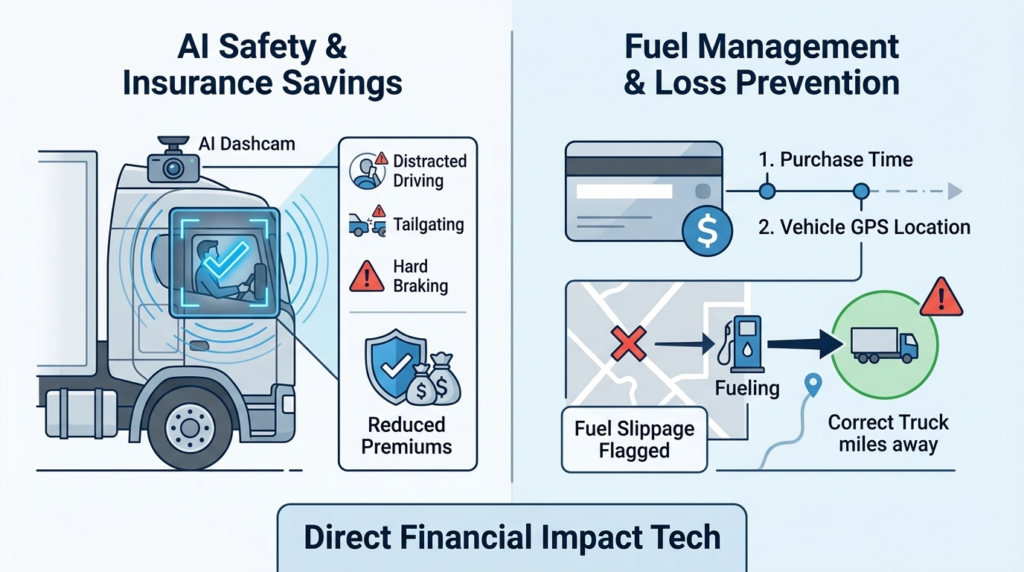
Modern AI dashcams process video directly inside the device using edge computing. The system recognizes risky behavior in real time—distracted driving, tailgating, hard braking, rolling through stop signs.
When the algorithm detects a problem, the driver gets an immediate in-cab alert.
That split-second warning matters.
Drivers correct the behavior instantly. Accidents drop. Insurance claims shrink.
Insurance carriers have noticed. Many providers now offer meaningful premium discounts to fleets that maintain high safety scores through AI monitoring platforms.
For some fleets, those insurance savings alone cover the monthly software subscription.
That’s not marketing hype. It’s basic math.
Fuel Management: Where Fleets Lose the Most Money
Fuel is still the second-largest operating expense in trucking.
And strangely, it’s one of the least controlled areas in many small fleets.
Receipts get lost. Drivers forget to log purchases. Dispatch has no way to see how efficiently vehicles are running.
That’s why fuel card integration for small fleets has become standard practice.
Real-Time Fuel Card Integration
Modern fleet platforms integrate directly with commercial fuel cards such as WEX or Fuelman.
Every transaction syncs with vehicle GPS data. The system instantly checks whether the purchase actually makes sense.
If a driver swipes a fuel card at a truck stop while the vehicle is parked ten miles away, the platform flags it immediately.
That’s called fuel slippage. And it happens more often than fleet owners realize.
Stopping that kind of leakage can save thousands per vehicle every year.
Mixed Fleets: Managing Gas and Electric Together
Another shift happening in 2026: fleets are no longer purely diesel.
Electric delivery vans and light-duty EV trucks are entering service across the logistics industry. Many companies now operate mixed fleets, running traditional internal combustion vehicles alongside electric models.
This creates a new management challenge.
Dispatchers must track both fuel levels and battery charge.
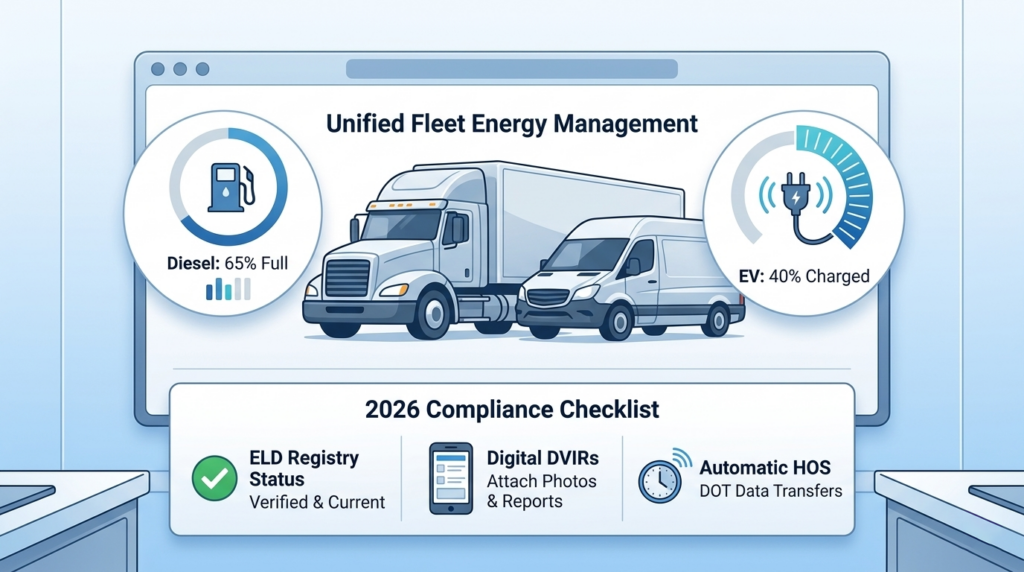
The newest fleet management platforms solve this by combining both energy types inside one dashboard. You’ll see diesel tank levels next to EV battery state-of-charge data.
That visibility helps dispatch teams assign the right vehicle to the right route.
Sometimes the best truck isn’t the closest one. It’s the one with the right energy profile.
ELD Compliance in 2026: What Fleets Need to Know
Compliance rules don’t stay still.
On January 1, 2026, the Federal Motor Carrier Safety Administration (FMCSA) performed a major cleanup of its Electronic Logging Device (ELD) registry. Devices that failed updated cybersecurity or connectivity standards were removed from the approved list.
For fleets still running older hardware, that created a problem overnight.
If a driver uses a non-compliant ELD and gets inspected roadside, the truck can be placed Out of Service (OOS). That means delays, penalties, and lost revenue.
Avoiding that scenario starts with a simple compliance check.
2026 Fleet Compliance Checklist
First, confirm that your ELD device is still listed in the FMCSA’s official registry.
If it isn’t, it needs to be replaced.
Next, look at your inspection process. Paper Driver Vehicle Inspection Reports are disappearing quickly. Fleets are switching to digital DVIR systems, where drivers submit vehicle inspection reports directly from a mobile app.
The advantage is speed.
Drivers can attach photos of defects—worn tires, broken lights, damaged brake components—and send them straight to the maintenance team. Repairs get scheduled faster.
Finally, ensure your system supports automatic Hours of Service (HOS) transfers. DOT inspectors increasingly request electronic log transfers through secure wireless connections during inspections.
If your system struggles with that process, you’re setting yourself up for headaches on the road.
Fleet Management Pricing in 2026
Most fleet technology platforms now follow a straightforward pricing structure: per vehicle, per month.
Hardware costs still exist, though many providers now bundle or lease equipment as part of the subscription.
Typical price ranges look like this:
Basic GPS tracking platforms generally fall between $20 and $30 per vehicle per month.
Systems that include ELD compliance, routing tools, and fuel integrations usually cost $35 to $50 per vehicle.
Premium safety packages—with AI dashcams and advanced driver analytics—can reach $60 to $85 or more per vehicle each month.
At first glance that might seem expensive. But the return on investment often shows up quickly.
Reduce fuel waste by five percent. Cut accident costs by ten percent.
Most fleets see the system pay for itself within four to six months.
The Future of Fleet Operations Is Data-Driven
Fleet management used to rely heavily on experience and instinct.
Experienced dispatchers knew their drivers. They knew which trucks ran efficiently and which routes caused delays.
That knowledge still matters. But data now amplifies it.
With modern fleet tracking platforms, managers can monitor vehicle health, safety performance, fuel spending, and compliance in real time. Decisions become faster. Problems get caught earlier.
And the companies that embrace this shift are pulling ahead.
Because managing a fleet in 2026 isn’t about watching trucks on a map.
It’s about running a data-driven operation where every vehicle, every route, and every gallon of fuel is measured and optimized.
The smartest move if you’re evaluating platforms?
Test them.
Most leading providers now offer trial deployments or proof-of-concept programs for qualified fleets. Install the hardware in a few trucks, run it for a month, and watch the data.
That’s when the difference becomes obvious.