

How Pain and Suffering Damages Are Calculated in Personal Injury Cases (2026 Guide)
When people hear about large personal injury settlements, they usually focus on the medical bills. Hospital charges. Surgery costs. Physical therapy invoices.
But in most serious injury cases, the biggest portion of compensation often comes from something harder to measure: pain and suffering.
And here’s the reality—insurance companies don’t simply guess those numbers. Not anymore.
By 2026, the process of calculating pain and suffering damages in personal injury lawsuits has become far more structured. Adjusters, attorneys, and courts rely on formulas, evidence patterns, and data models to justify the numbers that appear in settlement negotiations.
Still, it’s not purely mathematical. Human experience doesn’t fit neatly into spreadsheets.
Let’s break down how the system actually works.
The Two Types of Damages in Personal Injury Lawsuits
Every personal injury claim begins with the same legal structure. Damages fall into two categories: economic and non-economic.
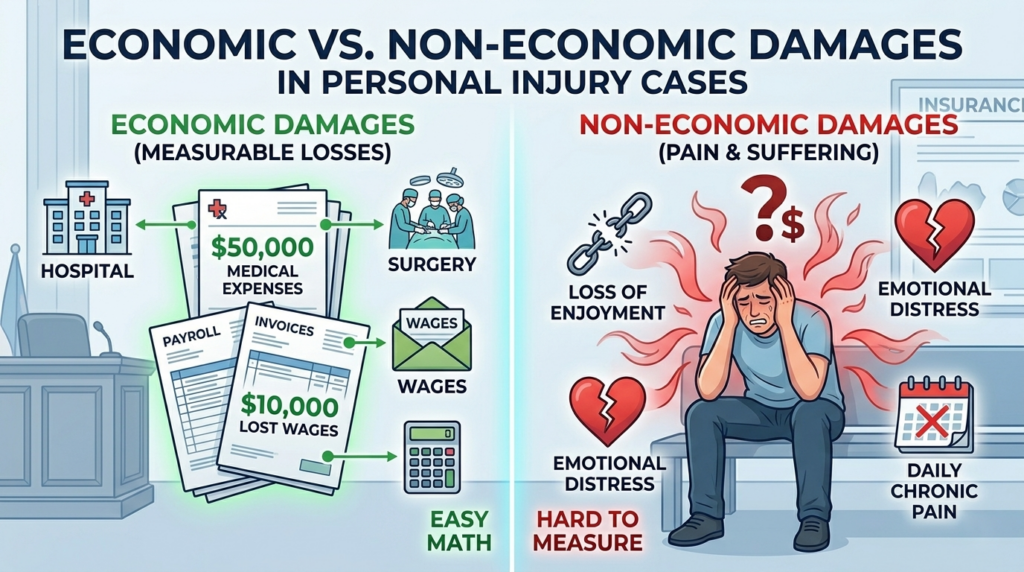
Economic Damages (The Easy Math)
Economic damages represent direct financial losses tied to the injury. These are measurable expenses with clear documentation.
Typical examples include:
- Emergency room treatment
- Surgery and hospital stays
- Prescription medication
- Physical therapy or rehabilitation
- Lost wages during recovery
- Future medical expenses
These numbers come from bills, payroll records, and expert medical projections. Add them together and you get a precise dollar amount.
Straightforward.
Non-Economic Damages (Where Pain and Suffering Lives)
Pain and suffering falls under non-economic damages, sometimes called general damages.
This category covers losses that don’t show up on invoices:
- Chronic physical pain
- Emotional distress
- Anxiety or depression following the injury
- Loss of enjoyment of life
- Reduced mobility or independence
- Long-term lifestyle changes
And here’s the challenge: there’s no receipt for any of this.
So how do courts assign a financial value to something deeply personal?
Attorneys and insurers rely on two widely accepted frameworks.
The Multiplier Method: The Industry Standard
The most common approach used in settlement negotiations is the multiplier method.
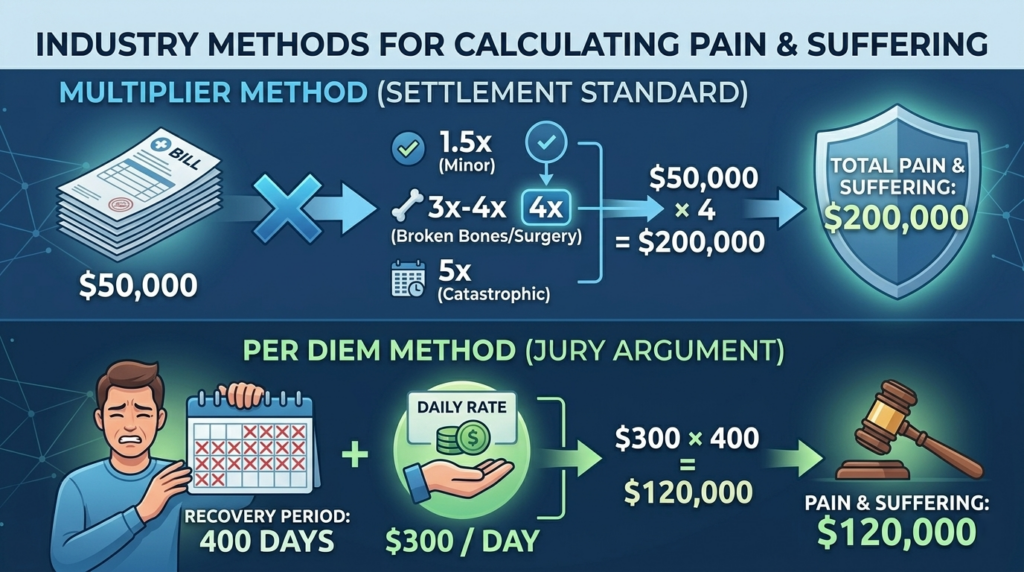
Insurance companies favor it because the calculation starts with something objective: total medical costs.
The idea is simple. The more serious the injury, the higher the multiplier applied to those medical expenses.
Typical Multiplier Ranges
Most cases fall within predictable brackets.
1.5× – 2× multiplier
Used for relatively minor injuries. Think sprains, mild whiplash, or soft-tissue damage where recovery happens within a few months.
3× – 4× multiplier
Applied when injuries involve broken bones, surgery, or long rehabilitation periods.
5× multiplier or higher
Reserved for catastrophic cases—permanent disability, severe disfigurement, or incidents involving extreme negligence, such as drunk driving.
Insurance companies quietly use internal software that mirrors this logic. In fact, many online pain and suffering calculator 2026 tools replicate the same framework.
Example Settlement Calculation
Let’s say a victim incurs:
- $50,000 in medical expenses
- A serious leg fracture requiring surgery and hardware implants
In that scenario, a 4× multiplier might be considered reasonable.
The breakdown would look like this:
Medical damages: $50,000
Pain and suffering (4×): $200,000
Total potential claim value: $250,000
Of course, the multiplier isn’t chosen randomly. Attorneys argue aggressively about the severity of injuries, the length of recovery, and the long-term impact on daily life.
And that debate can dramatically shift settlement numbers.
The Per Diem Method: Turning Pain Into a Daily Cost
Trial lawyers sometimes use a different strategy when presenting a case to a jury.
Instead of applying a multiplier, they assign a daily value to the plaintiff’s suffering. This is called the Per Diem method.
The logic resonates with juries because it frames the injury in human terms.
Here’s the typical argument:
“If it was worth $300 a day for my client to work before the accident, surely enduring constant pain is worth at least that much.”
That daily rate is then multiplied by the number of days the person suffers.
Example Per Diem Calculation
Assume:
Daily rate: $300
Recovery period: 400 days
The total pain and suffering damages would equal:
$300 × 400 = $120,000
This method often feels more relatable to jurors than abstract multipliers. It forces them to imagine living through the injury themselves—day after day.
Because of that emotional impact, attorneys sometimes combine both methods to find a persuasive middle ground during negotiations.
Evidence Matters More Than Ever in 2026
There was a time when plaintiffs could simply testify that they were in pain.
Those days are over.
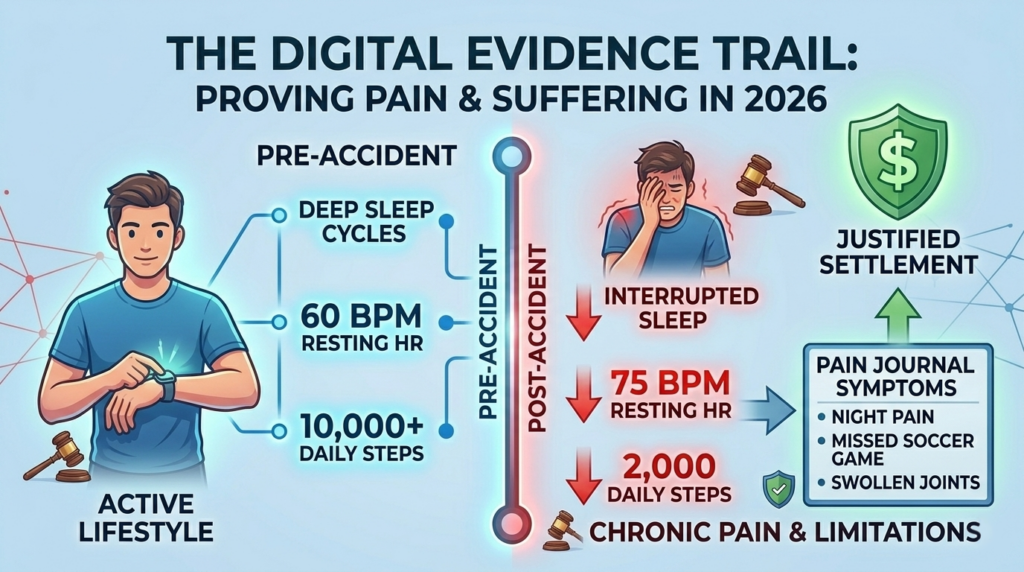
Insurance companies now demand evidence that supports non-economic damages, and modern technology has changed the game completely.
Successful claims today often rely on what lawyers call a digital evidence trail.
Wearable Technology Is Changing Injury Claims
Smart devices collect an enormous amount of health data.
And in personal injury litigation, that data can be incredibly valuable.
Devices like smartwatches and biometric rings record:
- Sleep quality
- Resting heart rate
- Activity levels
- Physical movement patterns
Attorneys can compare pre-accident and post-accident data to demonstrate measurable changes.
For example:
- Reduced daily steps
- Interrupted sleep cycles caused by pain
- Elevated heart rate linked to stress or discomfort
That objective data strengthens arguments for higher average settlement for pain and suffering.
It’s hard for insurers to dismiss numbers generated by a device someone wore every day for years.
Pain Journals: Simple but Powerful Evidence
Another underrated tool is the pain journal.
It doesn’t need to be complicated. A simple daily log describing symptoms, limitations, and emotional struggles can make a major difference.
Entries might include things like:
- “Couldn’t sleep because of shoulder pain.”
- “Missed my daughter’s soccer game because sitting hurts.”
- “Had to stop physical therapy early due to swelling.”
Over weeks and months, that record creates a detailed narrative of how the injury disrupted everyday life.
Judges and juries respond to that level of detail.
It turns abstract suffering into something tangible.
The Role of “Before and After” Witnesses
Friends, coworkers, and family members can also play a key role in proving pain and suffering.
These witnesses aren’t there to discuss the accident itself. Instead, they describe how the injured person changed afterward.
Maybe someone who once ran marathons now struggles to walk up stairs.
Maybe a previously outgoing person now avoids social gatherings because of chronic pain.
Those observations fill the emotional gap between raw medical data and the human experience behind it.
Damage Caps: The Legal Limits on Pain and Suffering
Not every state allows unlimited non-economic damages.
Some jurisdictions impose statutory caps—legal limits on how much a plaintiff can recover for pain and suffering.
These caps often apply to specific case types, particularly medical malpractice claims.
Common limits include:
- $250,000 cap
- $500,000 cap
Even if a jury believes the pain deserves more compensation, the court must reduce the award to match the legal limit.
That’s why consulting a personal injury lawyer early in the process is so important. Laws vary significantly from state to state, and the strategy used in one jurisdiction may fail in another.
An experienced attorney understands how to structure claims within those legal boundaries.
Why Insurance Companies Fight Pain and Suffering Claims
Here’s the uncomfortable truth: insurers know that non-economic damages often drive the size of settlements.
Medical bills are easy to verify. Pain and suffering is more flexible.
That flexibility makes it the primary battleground during negotiations.
Insurance adjusters frequently attempt to minimize these damages by arguing:
- The injuries aren’t severe
- Recovery happened quickly
- The pain isn’t well documented
Without strong evidence, they may offer settlements far below what the claim is truly worth.
The Bottom Line: Turning Human Suffering Into Legal Value
Putting a dollar amount on pain will never be perfect.
Every injury affects people differently. Two individuals with the same fracture may experience completely different recoveries, emotionally and physically.
That’s why experienced attorneys combine financial calculations, medical evidence, and personal narratives when building a claim.
A pain and suffering calculator can estimate a range. But real settlements depend on how convincingly the story of the injury is told—and proven.
And if there’s one lesson every injury victim should remember, it’s this:
Insurance companies are experts at protecting their money.
You deserve someone just as skilled protecting your recovery.