

Federal Tax Credit for Residential Solar Panels in 2026: What Homeowners Should Know About Form 5695
Installing solar panels isn’t just an environmental decision anymore. For many homeowners, it’s a financial strategy. Electricity prices keep climbing, equipment costs are slowly falling, and federal incentives are still strong—at least for now.
At the center of those incentives sits the Residential Clean Energy Credit, formerly called the Investment Tax Credit (ITC). If you installed a qualifying solar energy system, this credit can dramatically cut the real cost of going solar.
But here’s where people get confused. The rules depend on when your system becomes operational. The IRS doesn’t care when you signed the contract or when the installer started drilling mounts into your roof. What matters is the moment the system is “placed in service.”
That phrase means the solar system is fully installed, connected, and generating electricity.
If your system reached that stage during the 2025 tax year, the credit applies when you file taxes in 2026. And the credit is still generous: 30% of your qualified installation cost.
Let’s unpack what that actually means for your wallet.
The 30% Solar Tax Credit: How the Numbers Work
A lot of homeowners hear “30% credit” and assume it works like a deduction. It doesn’t.
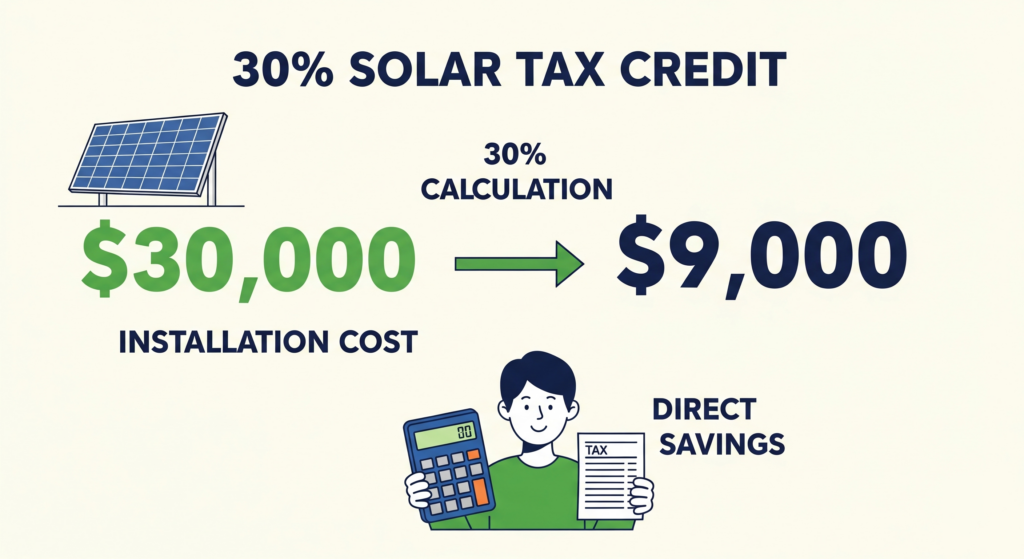
A deduction lowers your taxable income. A tax credit, on the other hand, reduces the amount of tax you owe dollar for dollar.
That difference is huge.
Imagine installing a mid-size residential solar system—around 10kW capacity. In 2026, the average installation price for a high-efficiency system like that lands around $30,000.
Here’s how the math plays out:
- Total solar installation cost: $30,000
- Federal tax credit (30%): $9,000
- Effective system cost after credit: $21,000
Now suppose your federal tax bill for the year is $10,000.
When you claim the credit, $9,000 disappears from that tax bill immediately. Instead of paying ten grand to the government, you owe just $1,000.
There’s another important detail many people miss. If your tax liability is smaller than the credit, the IRS doesn’t cancel the remainder. You can carry forward the unused credit to future tax years.
So if you only owe $6,000 this year, you still have $3,000 left to apply later.
That flexibility is one reason residential solar adoption keeps growing across the country.
What Actually Qualifies for the Solar Tax Credit
Filing Form 5695 sounds straightforward. But mistakes happen all the time—usually because homeowners misunderstand which costs qualify.
The IRS uses a very specific definition of “qualified solar electric property costs.”
Let’s break it down.
Equipment That Qualifies
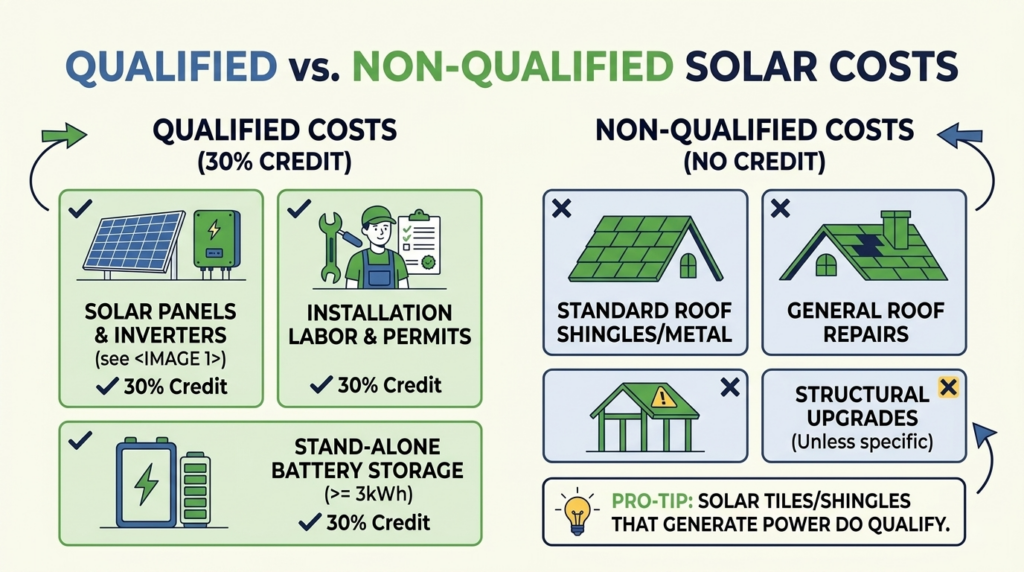
The most obvious component is the solar equipment itself:
- Solar photovoltaic panels
- Solar shingles or tiles that generate electricity
These form the core of your system, and the full cost counts toward the credit.
Installation and Labor Costs
Labor often represents a big portion of solar installation costs, and fortunately it’s included.
Qualified expenses typically include:
- Site preparation
- Assembly and installation labor
- Electrical wiring
- Mounting hardware and racking systems
- Inverters that convert solar power into usable electricity
- Permits and inspection fees
In short, if the cost is directly tied to installing the system, it likely qualifies.
Battery Storage Systems
Battery storage used to sit in a gray area. That changed recently.
As of 2026, stand-alone energy storage systems can qualify for the federal credit—even if they aren’t connected to solar panels.
The requirement is simple: the battery must provide at least 3 kilowatt-hours (kWh) of storage capacity.
That change opened the door for homeowners looking for the best home battery backup systems in 2026, especially in regions with unstable grids or frequent power outages.
The Roof Replacement Myth
Here’s a sales pitch that pops up surprisingly often.
Some solar installers suggest that if you replace your roof at the same time you install panels, the entire roofing project becomes eligible for the 30% tax credit.
It sounds great. Unfortunately, it’s mostly wrong.
Standard roofing materials—shingles, tiles, or metal roofing—do not qualify for the federal solar tax credit. The IRS sees those as structural components of the home, not energy equipment.
There’s one major exception: solar shingles or solar tiles that actually generate electricity. Products like these serve two functions at once—they replace the roof and produce power—so they can qualify.
Structural upgrades sometimes fall into a gray zone. For example, if an installer must reinforce roof framing to support the weight of solar panels, those costs may qualify.
The safest move? Keep detailed invoices and separate line items for every part of the project. Mixing roofing costs with solar costs can create serious problems during an audit.
How to File Form 5695
Claiming the Residential Clean Energy Credit happens during your regular federal tax filing.
Many taxpayers rely on software like TurboTax or H&R Block, which walk users through the process step by step. Still, understanding the form yourself helps prevent costly errors.
Here’s the basic workflow.
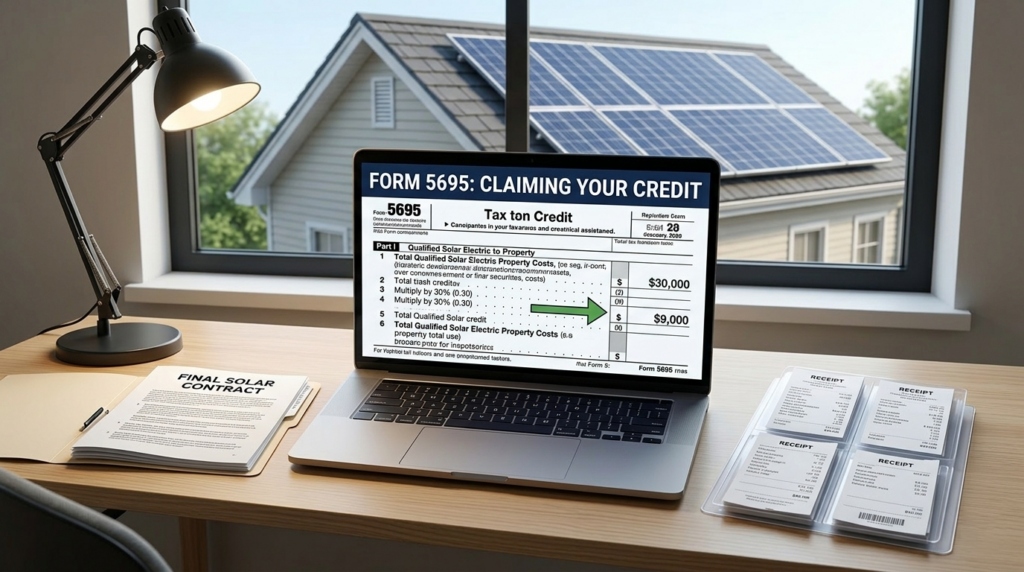
Step 1: Complete Part I of Form 5695
This section calculates your Residential Clean Energy Credit.
Start by entering your total qualified solar electric property costs. This includes panels, installation, equipment, and other eligible expenses.
If you installed a qualifying battery system, you’ll also record those costs here.
Step 2: Calculate the Credit
After entering your qualified costs, multiply the total by 30% (0.30).
That number becomes your potential tax credit.
Step 3: Transfer the Credit to Your Tax Return
The credit calculated on Form 5695 flows into Schedule 3 of Form 1040. From there, it reduces the total tax owed on your federal return.
If your tax liability is smaller than the credit amount, the unused portion automatically carries forward to future years.
Step 4: Keep Your Documentation
You don’t need to submit every receipt with your tax return. But you absolutely need to keep them.
Important documents include:
- Your final solar installation contract
- Itemized invoices and receipts
- A Manufacturer’s Certification Statement confirming equipment eligibility
If the IRS ever reviews your claim, these records will be essential.
Layering Federal, State, and Utility Incentives
The federal tax credit is powerful—but it’s only one piece of the incentive puzzle.
Depending on where you live, additional programs can significantly improve your solar return on investment.
State Tax Credits
Several states offer their own solar incentives that stack with the federal program.
For example, residents in states like Massachusetts and New York may qualify for additional state income tax credits after installing residential solar systems.
These programs vary widely, so homeowners should always check local regulations before installing a system.
Solar Renewable Energy Certificates (SRECs)
Some states use a market-based incentive system called SRECs.
In places such as New Jersey, solar owners earn certificates for every megawatt-hour their system generates. Utilities purchase those certificates to meet renewable energy requirements.
The result? Homeowners get paid for the electricity their panels produce.
Utility Rebates
Local power companies sometimes offer upfront rebates for solar installations.
One critical detail: rebates usually reduce the system cost used to calculate the federal tax credit.
Example:
If your solar system costs $30,000 but your utility provides a $3,000 rebate, the federal credit applies to $27,000, not the full installation price.
Is Solar Worth It in 2026?
From a financial perspective, residential solar remains one of the few home upgrades that can deliver a measurable return.
Energy savings accumulate year after year. Federal incentives slash installation costs. State programs add even more value.
For many American households, the break-even point arrives somewhere between six and nine years after installation.
After that, the electricity your system generates is essentially free.
Of course, tax policy never stays frozen forever. Federal energy incentives have already shifted several times over the past decade, and legislative changes in 2025 accelerated the phase-out schedule for some credits.
So before signing a five-figure installation contract, talk with a qualified tax professional. A short consultation can confirm whether your system qualifies—and ensure you capture every dollar of incentive available.
Because when it comes to solar tax credits, the difference between filing correctly and filing blindly can be thousands of dollars.