

Divorce Mediation vs. Litigation: Managing Legal Costs in the US in 2026
The Financial Reality of Divorce

A smart divorce isn’t about “winning” every point or proving you were right. It’s about choosing the right path—mediation or litigation—based on your circumstances. Do you let a neutral professional help you find compromise? Or do you hire two legal teams to battle it out in court? That decision alone can determine whether your post-divorce future is financially stable—or in jeopardy.
Mediation: Protecting Your Bottom Line
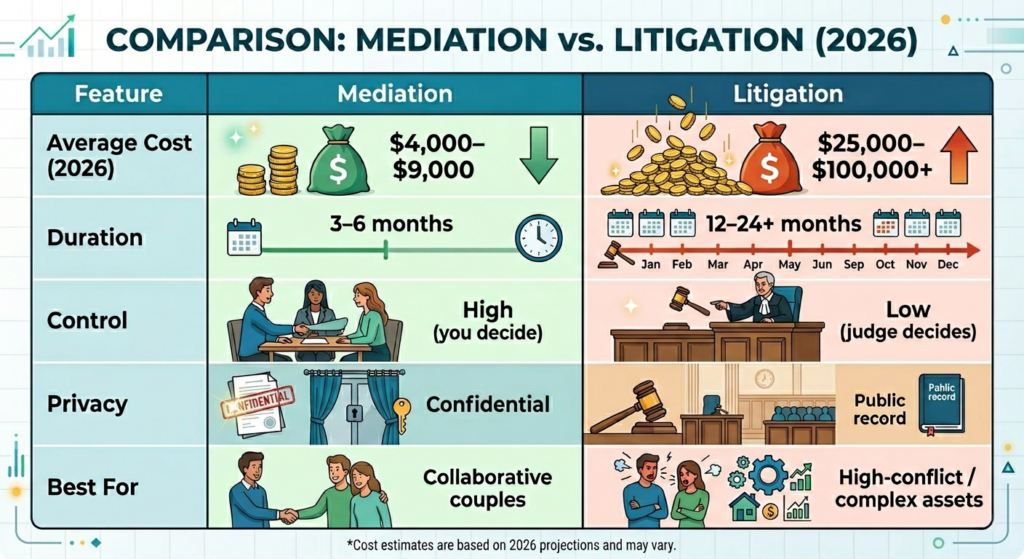
If both parties can communicate without escalating hostility, mediation can save tens of thousands of dollars. It’s no longer just an alternative; it’s often the most cost-effective route. In 2026, a typical mediated divorce costs between $4,000 and $8,000 total. Contrast that with a fully litigated divorce, which can exceed $50,000 or more.
How Mediation Works
Neutral Evaluation: The mediator—often a retired judge or senior family law attorney—guides discussions without taking sides.
Asset Transparency: Both spouses voluntarily share financial details. No subpoenas, no surprises—if everyone is honest.
Memorandum of Understanding (MOU): Once terms are agreed upon, the mediator drafts an MOU. Lawyers review it for legal soundness before the agreement is finalized.
Speed is another major benefit. A court battle can drag on 18 to 24 months, racking up billable hours. Mediation often wraps up in 3 to 6 months, drastically lowering costs while keeping control in your hands.
When Litigation Becomes Necessary
Mediation sounds ideal, but it isn’t a catch-all. Certain situations require the power and authority of a courtroom.
Hidden Assets and Complex Investments: Think Bitcoin, offshore accounts, or RSUs. If you suspect concealment or manipulation, mediation isn’t enough. Litigation allows subpoenas and formal discovery to uncover hidden assets.
Domestic Violence or Power Imbalances: Mediation requires equality at the table. A history of abuse or intimidation means negotiation is unsafe. Courtrooms offer legal protection that mediation cannot provide.
Business Valuation Disputes: Family-owned businesses or closely held companies often spark contentious valuations. When expert appraisals conflict, only a judge can provide a final, enforceable decision.
Understanding Lawyer Fees in 2026
Knowing how you’ll be billed is crucial. Family law firms primarily use two fee structures.
Hourly Rate & Retainer
Standard for contested cases.
Retainer: Often $5,000–$15,000 upfront, acting as a deposit against work performed.
Billable Increments: Most firms charge in six-minute increments (0.1 hour). Every call, text, and email counts.
Costs can escalate quickly if negotiations stall, discovery drags on, or expert testimony is needed.
Flat Fee Divorce
For uncontested cases with pre-agreed terms, some firms offer flat fee services. These cover filing, drafting, and document preparation for a set price—typically $2,500–$5,000. You know the total upfront, which removes billing surprises.
Hybrid Solutions: Picking and Choosing
Many smart divorcing couples in 2026 are taking a hybrid approach. You don’t need to litigate everything.
Segmented Mediation: Use mediation to settle lower-stakes issues—holiday schedules, furniture, small financial items.
Carve-Out Litigation: Reserve courtroom hours for high-stakes topics—primary residence valuation, spousal support, or complex investment disputes.
This strategy narrows the judge’s involvement to essential matters. It can reduce legal fees by 50% or more while still providing full judicial authority where it counts.
Cutting Costs Without Cutting Corners
Divorce is emotional and financial. Managing both is critical.
Organize Financial Documents: Clean, indexed folders with tax returns, bank statements, and RSU grant letters save lawyers hours of administrative work. Time is money.
Emotional Management: Therapy is for emotional venting. Your lawyer should not double as a therapist. Every hour with a $600-an-hour attorney is precious.
Initial Consultation: Many firms offer low-cost or free consultations. Use these to evaluate fee structures and “chemistry” before signing a retainer.
Assess Complexity: Ask yourself—are your assets straightforward W-2 income and home equity? Or are you juggling businesses, investments, and high-conflict personalities? Knowing the complexity level now helps you select the right professional and avoid financial disaster.
Why Mediation Isn’t Always Enough
You might wonder, “If mediation is cheaper, why not always use it?” Because mediation assumes cooperation and transparency. When suspicion, hidden assets, or power imbalance exists, you need more than goodwill.
Courtrooms provide tools mediation cannot: subpoenas, formal discovery, and enforceable orders. And sometimes, a judge’s authority ensures fair valuation of complex assets. Ignoring this reality can cost far more than mediation ever would.
Planning Your Divorce Like a Project
Think of yourself as the project manager of your own divorce. Every decision affects the final budget.
- Prioritize documentation.
- Decide which disputes truly require a judge.
- Separate emotional venting from legal strategy.
- Use mediation for low-stakes matters, litigation for high-stakes.
With careful planning, divorce doesn’t have to destroy savings. You can retain control, protect your financial future, and still allow the legal system to arbitrate where necessary.
The Bottom Line
Divorce is costly. By 2026, hourly rates and complex financial assets make strategy critical. Mediation saves money and speeds up resolution when spouses can negotiate fairly. Litigation protects you when stakes are high or when trust is absent. A hybrid approach often offers the best balance.
Act with intention. Organize documents. Understand fees. Choose the path that matches your case. Protect your assets and your future.
The smartest move isn’t winning small battles—it’s ensuring that, at the end, you walk away with both dignity and financial stability. If that means consulting a mediator or collaborative law expert today, do it. Your future self will thank you.