

AI-Driven CRM Tools for Real Estate Agents: How Top Producers Are Closing More Deals in 2026
The real estate market in 2026 feels different. Not slower, exactly. Just…more cautious.
Here’s the uncomfortable truth many agents are discovering: speed and memory matter more than charisma now.
Clients expect responses in minutes. They assume you remember every property they clicked on, every neighborhood they explored, every price range they filtered.
Humans can’t keep up with that manually.
That’s why high-performing agents have shifted toward AI-driven CRM platforms. The best real estate CRM with AI in 2026 doesn’t just store contacts. It watches behavior, prioritizes leads, and triggers follow-ups automatically.
The result? Agents spend less time chasing spreadsheets and more time closing deals.
Predictive Lead Scoring: Why “Fast” Isn’t Enough Anymore
For years, real estate teams operated on one rule: whoever calls the lead first wins.
That’s still partly true. But speed alone doesn’t solve the deeper problem—not every lead deserves the same attention.
Some prospects are casually browsing.
Others are ready to move next week.
Without good data, agents treat them exactly the same.
Predictive lead scoring changes that.
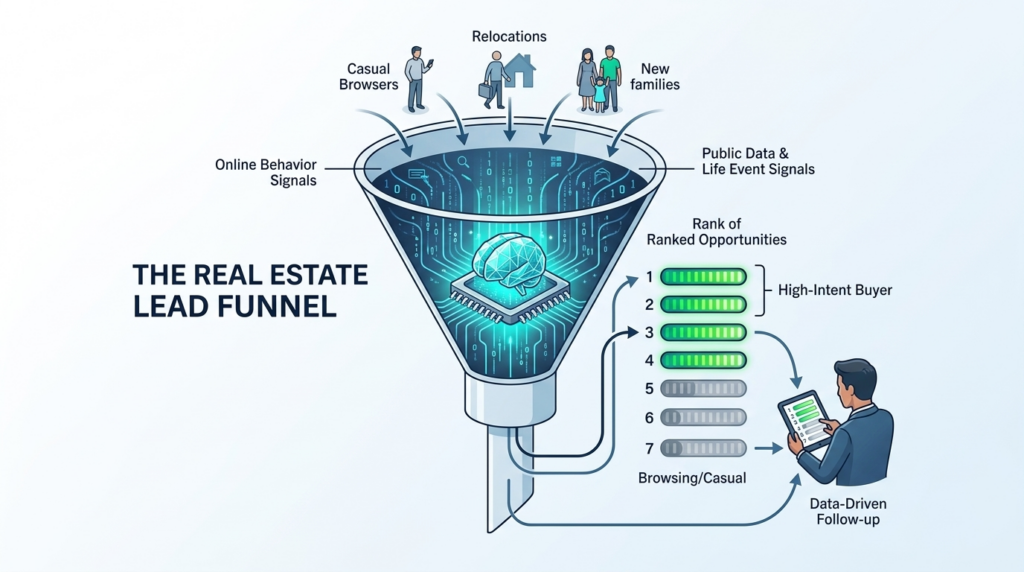
Instead of guessing which prospects matter most, the CRM assigns each lead a probability score based on behavioral signals and external data patterns.
In other words, it ranks opportunity.
How AI Evaluates a Real Estate Lead
Modern predictive lead scoring software processes far more information than traditional CRMs ever could.
A few examples:
Online behavior signals
The system tracks what prospects actually do online. Which listings they save. How long they stay on certain property pages. Whether they repeatedly return to the same neighborhood.
If someone spends ten minutes studying school district boundaries and comparing home layouts, that’s not casual browsing.
That’s intent.
Public data and life-event signals
AI systems also scan available data sources that hint at major life changes—job promotions, relocations, family growth, or new business registrations.
You might not notice those signals manually.
The CRM does.
Smart Lead Routing in Action
Let’s say a new inquiry comes in from a Facebook ad promoting homes in a suburban neighborhood.
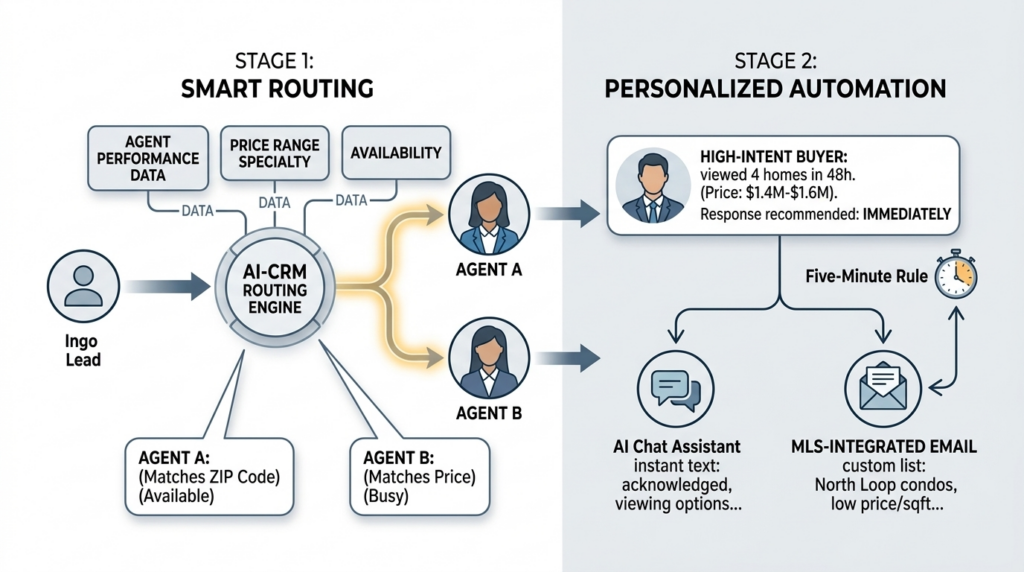
Instead of dropping that lead into a shared inbox or blasting it to every agent, the CRM evaluates a few things first.
Who on the team closes the most deals in that ZIP code?
Who specializes in that price range?
Who currently has availability to respond?
Then the platform sends the lead to the agent most likely to convert it.
Sometimes the system even pushes a mobile alert with context.
Something like this:
“High-intent buyer. Viewed four homes in the past 48 hours. Price range $1.4M–$1.6M. Response recommended immediately.”
That level of targeting makes a difference.
It keeps strong leads from slipping through the cracks.
Why Generic Email Drip Campaigns No Longer Work
Remember those classic drip campaigns?
“Happy Tuesday! Just checking in to see if you’re still looking for a home.”
Most buyers ignore them now.
Inbox filters are smarter. Consumers are more impatient. Generic messages feel like noise.
The problem isn’t automation. The problem is irrelevance.
Modern CRMs fix this by turning follow-up into a personalized conversation instead of a template blast.
Speed-to-Lead: The Five-Minute Rule
There’s a statistic most real estate teams know but struggle to execute on.
Leads contacted within five minutes are over 20 times more likely to convert than leads contacted later.
But let’s be realistic.
No agent can monitor inquiries every minute of the day.
That’s where automated follow-up emails for realtors and AI chat assistants come in.
When a new inquiry arrives, the CRM responds instantly—often within seconds.
The prospect receives a text message or email acknowledging their request, offering property details, and sometimes even scheduling a viewing.
The agent steps in afterward with the human conversation.
This simple change cuts response time dramatically. Many teams reduce average response time from an hour to under a minute.
And yes, that alone can double conversion rates for online leads.
MLS Integration and Personalized Market Updates
Another big change in 2026: buyers expect curated information, not generic listing alerts.
Sending a long list of random properties doesn’t impress anyone.
Modern AI-powered CRMs integrate directly with MLS data to generate personalized market updates based on each client’s browsing behavior.
Let’s say a buyer frequently views three-bedroom condos in a particular neighborhood.
Instead of emailing a generic list, the CRM might send a note like this:
“A new listing just appeared in the North Loop area. Price per square foot is about 9% lower than similar homes you viewed earlier this week. Want the virtual tour link?”
That message feels thoughtful—even though the AI generated it.
And that’s the point.
Automation works best when it feels human.
Zillow and Realtor.com Integration: The Data Advantage
Here’s something many buyers don’t realize.
Every time they browse homes online, they leave behavioral clues.
Top agents capture those signals using Zillow lead automation tools connected directly to their CRM.
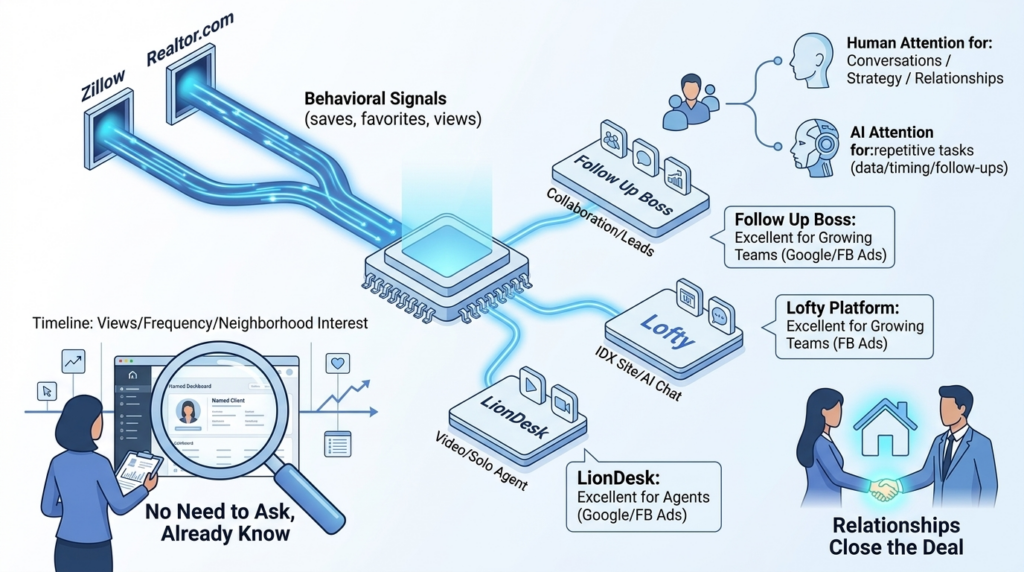
When a prospect saves a property on Zillow or favorites a listing on Realtor.com, the activity syncs automatically with the agent’s database.
That creates a detailed activity timeline.
Agents can see which properties someone viewed, how often they returned to certain listings, and which neighborhoods caught their attention.
You don’t have to ask, “What areas are you interested in?”
You already know.
Better yet, the system can trigger actions automatically—sending property alerts, recommending similar homes, or scheduling showings through integrated calendars.
This type of automation saves agents an enormous amount of administrative work.
Many teams estimate it eliminates 10–12 hours of manual tasks each week.
Choosing the Best AI CRM for Real Estate in 2026
Not every CRM fits every type of agent.
Team size, marketing strategy, and budget all play a role.
Three platforms dominate the conversation in 2026.
Follow Up Boss
Follow Up Boss remains one of the most popular CRMs for growing real estate teams.
The platform excels at collaboration and lead distribution. Teams running multiple advertising channels—Google Ads, Facebook campaigns, referral networks—often rely on it to keep everything organized.
Its automation tools, called Action Plans, guide agents through follow-up steps automatically.
For teams managing high lead volume, that structure helps maintain consistency.
Lofty (formerly Chime)
Lofty takes a different approach.
Instead of focusing solely on CRM features, it delivers a full marketing ecosystem—IDX websites, AI chat assistants, advertising management, and lead generation tools.
Think of it as an all-in-one real estate operating system.
Agents who want deep automation and advanced AI often gravitate toward Lofty, though the platform typically sits at the higher end of the pricing spectrum.
LionDesk
LionDesk targets solo agents and smaller teams.
It offers solid automation features without the complexity—or cost—of larger enterprise systems.
Video messaging, smart drip campaigns, and advertising integrations make it particularly appealing for agents building their businesses independently.
For someone transitioning from spreadsheets to a full CRM, LionDesk provides an accessible starting point.
The Future of Real Estate Sales Is AI-Assisted
Some agents worry that artificial intelligence will replace traditional real estate work.
That fear misses the real shift happening.
AI handles the repetitive tasks: sorting leads, sending reminders, tracking behavior, scheduling follow-ups.
But buying a home remains emotional. Complicated. Sometimes stressful.
Clients still need guidance when negotiations get tense or when inspections reveal unexpected issues.
Technology doesn’t replace that human role.
It amplifies it.
When an AI-driven CRM manages the data and the timing, agents regain something valuable: attention.
Attention for conversations. For strategy. For relationships.
And in real estate, relationships still close the deal.